Ch. 7 - Transcendental Functions
Hass - Thomas' Calculus 15th Edition
Hass15th EditionThomas' CalculusISBN: 9780137616077Non è quello che usi tu?Cambia libro di testo
Capitolo 7, Problema 7.3.141

In Exercises 139–142, find the length of each curve.
141. y = ln(cos(x)) from x = 0 to x = π/4.

Guida verificata passo dopo passo
1
Recall the formula for the length of a curve defined by a function \(y = f(x)\) from \(x = a\) to \(x = b\): \[L = \int_a^b \sqrt{1 + \left(\frac{dy}{dx}\right)^2} \, dx\]
Identify the function given: \[y = \ln(\cos(x))\] with the interval from \(x = 0\) to \(x = \frac{\pi}{4}\).
Find the derivative \(\frac{dy}{dx}\) using the chain rule: Since \(y = \ln(u)\) where \(u = \cos(x)\), then \[\frac{dy}{dx} = \frac{1}{u} \cdot \frac{du}{dx} = \frac{1}{\cos(x)} \cdot (-\sin(x)) = -\tan(x)\]
Substitute \(\frac{dy}{dx} = -\tan(x)\) into the arc length formula: \[L = \int_0^{\frac{\pi}{4}} \sqrt{1 + (-\tan(x))^2} \, dx = \int_0^{\frac{\pi}{4}} \sqrt{1 + \tan^2(x)} \, dx\]
Use the trigonometric identity \(1 + \tan^2(x) = \sec^2(x)\) to simplify the integrand: \[L = \int_0^{\frac{\pi}{4}} \sqrt{\sec^2(x)} \, dx = \int_0^{\frac{\pi}{4}} |\sec(x)| \, dx\] Since \(\sec(x)\) is positive on \([0, \frac{\pi}{4}]\), this becomes \[L = \int_0^{\frac{\pi}{4}} \sec(x) \, dx\] The next step would be to evaluate this integral.

Risposta video verificata per un problema simile:

Questa soluzione video è stata consigliata dai nostri tutor come utile per risolvere questo problema.
Durata del video:
5m

Concetti chiave

Ecco i concetti essenziali che devi comprendere per rispondere correttamente alla domanda.

Arc Length Formula

The arc length of a curve y = f(x) from x = a to x = b is given by the integral L = ∫_a^b √(1 + (dy/dx)^2) dx. This formula calculates the length by summing infinitesimal line segments along the curve.
Video consigliato:
Percorso guidato
06:29
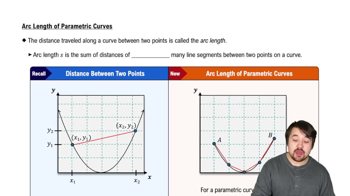
Arc Length of Parametric Curves

Derivative of y = ln(cos(x))

To find the arc length, you need the derivative dy/dx. For y = ln(cos(x)), use the chain rule: dy/dx = -tan(x), since the derivative of ln(u) is 1/u * du/dx and d/dx[cos(x)] = -sin(x).
Video consigliato:
04:56
Derivative of the Natural Exponential Function (e^x)

Integration Techniques for Arc Length

Evaluating the arc length integral often requires simplifying the integrand and applying appropriate integration methods, such as substitution or recognizing standard integral forms, to compute the exact length over the given interval.
Video consigliato:
Percorso guidato
06:29
Arc Length of Parametric Curves