Ch. 7 - Transcendental Functions
Hass - Thomas' Calculus 15th Edition
Hass15th EditionThomas' CalculusISBN: 9780137616077Non è quello che usi tu?Cambia libro di testo
Capitolo 7, Problema 7.2.6

In Exercises 5 and 6, solve for t.
6. ln(t-2) = ln8 - ln(t)

Guida verificata passo dopo passo
1
Start with the given equation: \(\ln(t - 2) = \ln 8 - \ln t\).
Use the logarithm property that \(\ln a - \ln b = \ln \left( \frac{a}{b} \right)\) to combine the right side: \(\ln(t - 2) = \ln \left( \frac{8}{t} \right)\).
Since the natural logarithm function \(\ln x\) is one-to-one, set the arguments equal to each other: \(t - 2 = \frac{8}{t}\).
Multiply both sides of the equation by \(t\) to eliminate the denominator: \(t(t - 2) = 8\).
Expand and rearrange the equation into standard quadratic form: \(t^2 - 2t - 8 = 0\). Then solve this quadratic equation for \(t\).

Risposta video verificata per un problema simile:

Questa soluzione video è stata consigliata dai nostri tutor come utile per risolvere questo problema.
Durata del video:
1m

Concetti chiave

Ecco i concetti essenziali che devi comprendere per rispondere correttamente alla domanda.

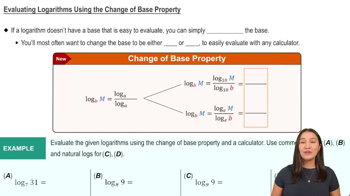
Properties of Logarithms

Logarithmic properties, such as the difference rule ln(a) - ln(b) = ln(a/b), allow us to combine or separate logarithmic expressions. These properties are essential for simplifying equations involving logarithms and solving for variables inside the log functions.
Video consigliato:
05:36
Change of Base Property

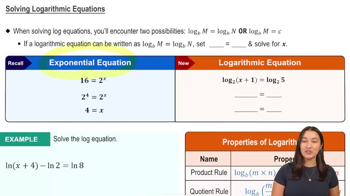
Solving Logarithmic Equations

To solve logarithmic equations, we often rewrite the equation using log properties to isolate the logarithm on one side, then exponentiate both sides to eliminate the logarithm. This transforms the equation into an algebraic form that can be solved for the variable.
Video consigliato:
5:02
Solving Logarithmic Equations

Domain Restrictions of Logarithmic Functions

The argument of a logarithm must be positive, so when solving equations like ln(t-2) = ln8 - ln(t), we must ensure t-2 > 0 and t > 0. These domain restrictions are crucial to identify valid solutions and exclude extraneous ones.
Video consigliato:
5:26
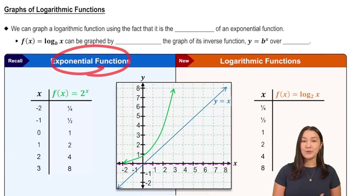
Graphs of Logarithmic Functions