
Ch. 7 - Transcendental Functions
Hass - Thomas' Calculus 15th Edition
Hass15th EditionThomas' CalculusISBN: 9780137616077Non è quello che usi tu?Cambia libro di testo
Capitolo 7, Problema 7.3.73

In Exercises 59–86, find the derivative of y with respect to the given independent variable.
73. y = log₄ x + log₄ x²

Guida verificata passo dopo passo
1
Recall that the logarithm with base 4 can be rewritten using the change of base formula: \(\log_4 x = \frac{\ln x}{\ln 4}\), where \(\ln\) is the natural logarithm.
Rewrite the given function \(y = \log_4 x + \log_4 x^2\) as \(y = \frac{\ln x}{\ln 4} + \frac{\ln x^2}{\ln 4}\).
Use the logarithm power rule on \(\ln x^2\) to simplify it to \(2 \ln x\), so the function becomes \(y = \frac{\ln x}{\ln 4} + \frac{2 \ln x}{\ln 4}\).
Combine the terms to get \(y = \frac{\ln x + 2 \ln x}{\ln 4} = \frac{3 \ln x}{\ln 4}\).
Differentiate \(y\) with respect to \(x\) using the derivative of \(\ln x\), which is \(\frac{1}{x}\), and treat \(\frac{3}{\ln 4}\) as a constant multiplier. So, \(\frac{dy}{dx} = \frac{3}{\ln 4} \cdot \frac{1}{x}\).

Risposta video verificata per un problema simile:

Questa soluzione video è stata consigliata dai nostri tutor come utile per risolvere questo problema.
Durata del video:
1m

Concetti chiave

Ecco i concetti essenziali che devi comprendere per rispondere correttamente alla domanda.

Logarithmic Functions and Their Properties

Logarithmic functions are the inverses of exponential functions and have specific properties such as log_b(xy) = log_b(x) + log_b(y) and log_b(x^n) = n log_b(x). Understanding these properties helps simplify expressions before differentiation.
Video consigliato:
Percorso guidato
06:21
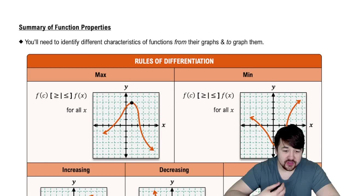
Properties of Functions

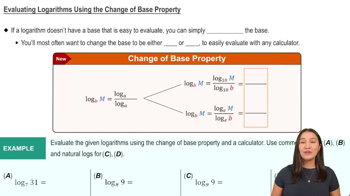
Change of Base Formula

The change of base formula, log_b(x) = ln(x) / ln(b), allows rewriting logarithms with any base in terms of natural logarithms, which are easier to differentiate using standard rules.
Video consigliato:
05:36
Change of Base Property

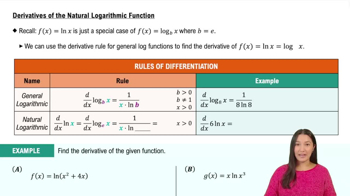
Derivative of Logarithmic Functions

The derivative of ln(x) with respect to x is 1/x. Using the chain rule and the change of base formula, the derivative of log_b(x) is 1 / (x ln(b)), which is essential for finding the derivative of logarithms with bases other than e.
Video consigliato:
05:18
Derivative of the Natural Logarithmic Function