Ch. 7 - Transcendental Functions
Hass - Thomas' Calculus 15th Edition
Hass15th EditionThomas' CalculusISBN: 9780137616077Non è quello che usi tu?Cambia libro di testo
Capitolo 7, Problema 7.3.71

In Exercises 59–86, find the derivative of y with respect to the given independent variable.
71. y = log₂(5θ)

Guida verificata passo dopo passo
1
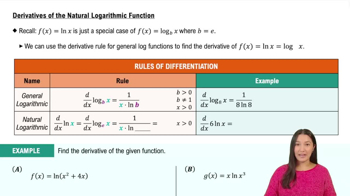
Recall the formula for the derivative of a logarithm with an arbitrary base: if \( y = \log_a(u) \), then \( \frac{dy}{dx} = \frac{1}{u \ln(a)} \cdot \frac{du}{dx} \), where \( \ln \) is the natural logarithm.
Identify the base \( a \) and the argument \( u \) in the given function. Here, \( y = \log_2(5\theta) \), so \( a = 2 \) and \( u = 5\theta \).
Compute the derivative of the inside function \( u = 5\theta \) with respect to \( \theta \). Since \( 5 \) is a constant, \( \frac{du}{d\theta} = 5 \).
Apply the derivative formula: \( \frac{dy}{d\theta} = \frac{1}{5\theta \ln(2)} \times 5 \).
Simplify the expression by canceling common factors if possible to express the derivative in its simplest form.

Risposta video verificata per un problema simile:

Questa soluzione video è stata consigliata dai nostri tutor come utile per risolvere questo problema.
Durata del video:
2m

Concetti chiave

Ecco i concetti essenziali che devi comprendere per rispondere correttamente alla domanda.

Derivative of Logarithmic Functions

The derivative of a logarithmic function depends on its base. For a logarithm with base a, log_a(x), the derivative is 1/(x ln(a)) times the derivative of x. Understanding this allows you to differentiate log₂(5θ) by applying the chain rule.
Video consigliato:
05:18
Derivative of the Natural Logarithmic Function

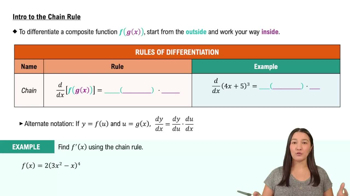
Chain Rule

The chain rule is used to differentiate composite functions. When a function is inside another, like 5θ inside the logarithm, you first differentiate the outer function with respect to the inner function, then multiply by the derivative of the inner function.
Video consigliato:
05:02
Intro to the Chain Rule

Properties of Logarithms

Logarithmic properties, such as log_a(bx) = log_a(b) + log_a(x), can simplify differentiation. Recognizing these properties helps break down complex logarithmic expressions into simpler parts, making differentiation more straightforward.
Video consigliato:
05:36
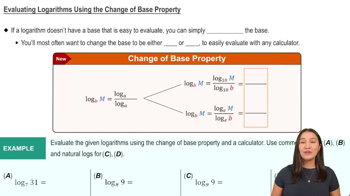
Change of Base Property