Ch. 7 - Transcendental Functions
Hass - Thomas' Calculus 15th Edition
Hass15th EditionThomas' CalculusISBN: 9780137616077Non è quello che usi tu?Cambia libro di testo
Capitolo 7, Problema 7.3.81

In Exercises 59–86, find the derivative of y with respect to the given independent variable.
81. y = log₁₀(e^x)

Guida verificata passo dopo passo
1
Recognize that the function is given as \(y = \log_{10}(e^x)\), which is a logarithm with base 10 of the expression \(e^x\).
Use the logarithm property that allows you to rewrite \(\log_{10}(e^x)\) as \(x \cdot \log_{10}(e)\), since \(\log_b(a^c) = c \cdot \log_b(a)\).
Recall that \(\log_{10}(e)\) is a constant because it does not depend on \(x\).
Differentiate \(y = x \cdot \log_{10}(e)\) with respect to \(x\) using the constant multiple rule, which states that the derivative of \(c \cdot f(x)\) is \(c \cdot f'(x)\) where \(c\) is a constant.
Since the derivative of \(x\) with respect to \(x\) is 1, the derivative \(\frac{dy}{dx}\) simplifies to \(\log_{10}(e)\).

Risposta video verificata per un problema simile:

Questa soluzione video è stata consigliata dai nostri tutor come utile per risolvere questo problema.
Durata del video:
1m

Concetti chiave

Ecco i concetti essenziali che devi comprendere per rispondere correttamente alla domanda.

Logarithmic Functions and Their Properties

Logarithmic functions are the inverses of exponential functions. Understanding properties like logₐ(b^x) = x·logₐ(b) helps simplify expressions before differentiation. In this problem, recognizing that log₁₀(e^x) can be rewritten using these properties is essential.
Video consigliato:
Percorso guidato
06:21
Properties of Functions

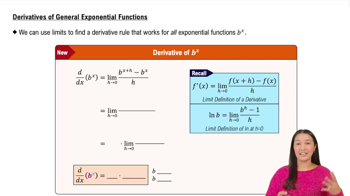
Derivative of Exponential Functions

The derivative of an exponential function e^x with respect to x is e^x. This fundamental rule is crucial when differentiating expressions involving exponentials, especially when combined with logarithmic functions.
Video consigliato:
04:50
Derivatives of General Exponential Functions

Chain Rule for Differentiation

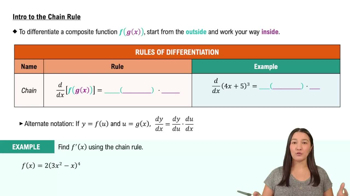
The chain rule is used to differentiate composite functions. When a function is nested inside another, like log₁₀(e^x), the derivative is the derivative of the outer function evaluated at the inner function times the derivative of the inner function.
Video consigliato:
05:02
Intro to the Chain Rule