Ch. 7 - Transcendental Functions
Hass - Thomas' Calculus 15th Edition
Hass15th EditionThomas' CalculusISBN: 9780137616077Non è quello che usi tu?Cambia libro di testo
Capitolo 7, Problema 7.2.10

In Exercises 7–38, find the derivative of y with respect to x, t, or θ, as appropriate.
10. y = ln(t^(3/2))

Guida verificata passo dopo passo
1
Recognize that the function is given as \(y = \ln\left(t^{\frac{3}{2}}\right)\), which is a natural logarithm of a power function.
Use the logarithmic property that allows you to bring the exponent in front: \(\ln\left(t^{\frac{3}{2}}\right) = \frac{3}{2} \ln(t)\).
Rewrite the function as \(y = \frac{3}{2} \ln(t)\) to simplify differentiation.
Recall the derivative of \(\ln(t)\) with respect to \(t\) is \(\frac{1}{t}\), so apply the constant multiple rule to get \(\frac{dy}{dt} = \frac{3}{2} \cdot \frac{1}{t}\).
Express the derivative as \(\frac{dy}{dt} = \frac{3}{2t}\), which is the derivative of the original function with respect to \(t\).

Risposta video verificata per un problema simile:

Questa soluzione video è stata consigliata dai nostri tutor come utile per risolvere questo problema.
Durata del video:
1m

Concetti chiave

Ecco i concetti essenziali che devi comprendere per rispondere correttamente alla domanda.

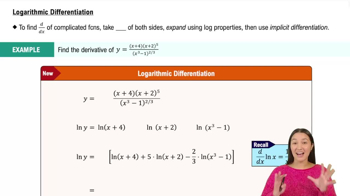
Logarithmic Differentiation

Logarithmic differentiation involves applying the derivative rules to functions involving logarithms. The derivative of ln(u), where u is a function of the variable, is (1/u) times the derivative of u. This technique simplifies differentiation of functions expressed as logarithms.
Video consigliato:
06:30
Logarithmic Differentiation

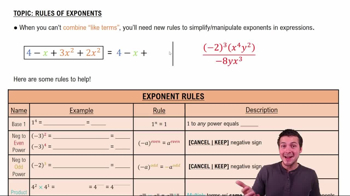
Power Rule for Exponents

The power rule states that the derivative of t^n with respect to t is n * t^(n-1). This rule is essential when differentiating expressions where the variable is raised to a constant exponent, such as t^(3/2) in the given function.
Video consigliato:
7:39
Introduction to Exponent Rules

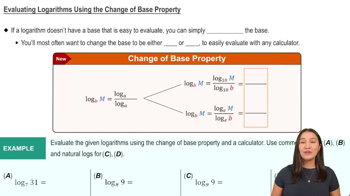
Properties of Logarithms

Logarithmic properties, like ln(a^b) = b * ln(a), allow simplification of expressions before differentiation. Applying these properties can transform complex logarithmic functions into simpler forms, making differentiation more straightforward.
Video consigliato:
05:36
Change of Base Property