

Ch. 7 - Transcendental Functions
Hass - Thomas' Calculus 15th Edition
Hass15th EditionThomas' CalculusISBN: 9780137616077Non è quello che usi tu?Cambia libro di testo
Capitolo 7, Problema 7.2.14

In Exercises 7–38, find the derivative of y with respect to x, t, or θ, as appropriate.
14. y = ln(2θ+2)

Guida verificata passo dopo passo
1
Identify the function given: \(y = \ln(2\theta + 2)\), where \(y\) is expressed in terms of \(\theta\).
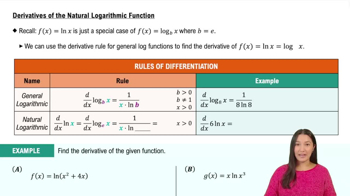
Recall the derivative rule for the natural logarithm function: if \(y = \ln(u)\), then \(\frac{dy}{d\theta} = \frac{1}{u} \cdot \frac{du}{d\theta}\).
Set \(u = 2\theta + 2\) and find its derivative with respect to \(\theta\): \(\frac{du}{d\theta} = 2\).
Apply the chain rule by substituting \(u\) and \(\frac{du}{d\theta}\) into the derivative formula: \(\frac{dy}{d\theta} = \frac{1}{2\theta + 2} \cdot 2\).
Simplify the expression if possible to write the derivative in its simplest form.

Risposta video verificata per un problema simile:

Questa soluzione video è stata consigliata dai nostri tutor come utile per risolvere questo problema.
Durata del video:
2m

Concetti chiave

Ecco i concetti essenziali che devi comprendere per rispondere correttamente alla domanda.

Derivative of the Natural Logarithm Function

The derivative of ln(u), where u is a differentiable function of a variable, is given by (1/u) times the derivative of u. This rule allows us to differentiate logarithmic functions by applying the chain rule to the inner function.
Video consigliato:
05:18
Derivative of the Natural Logarithmic Function

Chain Rule

The chain rule is used to differentiate composite functions. It states that the derivative of a function composed of another function is the derivative of the outer function evaluated at the inner function times the derivative of the inner function.
Video consigliato:
05:02
Intro to the Chain Rule

Differentiation with Respect to a Variable

When differentiating, it is important to identify the variable with respect to which the derivative is taken. In this problem, the variable is θ, so all derivatives must be computed considering θ as the independent variable.
Video consigliato:
07:15
Separation of Variables