Ch. 7 - Transcendental Functions
Hass - Thomas' Calculus 15th Edition
Hass15th EditionThomas' CalculusISBN: 9780137616077Non è quello che usi tu?Cambia libro di testo
Capitolo 7, Problema 7.5.55

Indeterminate Powers and Products
Find the limits in Exercises 53–68.
55. lim (x → ∞) (ln x)^(1/x)

Guida verificata passo dopo passo
1
Identify the limit expression: \(\lim_{x \to \infty} (\ln x)^{\frac{1}{x}}\).
Recognize that the expression is of the form \(f(x)^{g(x)}\) where both the base and the exponent depend on \(x\). To handle limits of this form, it is often helpful to rewrite the expression using the exponential and logarithm functions.
Rewrite the expression as \(e^{\ln\left((\ln x)^{\frac{1}{x}}\right)} = e^{\frac{1}{x} \ln(\ln x)}\).
Focus on finding the limit of the exponent: \(\lim_{x \to \infty} \frac{\ln(\ln x)}{x}\). Analyze the behavior of the numerator and denominator as \(x\) approaches infinity.
Since \(\ln(\ln x)\) grows very slowly compared to \(x\), the fraction \(\frac{\ln(\ln x)}{x}\) approaches zero. Therefore, the original limit becomes \(e^0\), which you can interpret to find the final limit.

Risposta video verificata per un problema simile:

Questa soluzione video è stata consigliata dai nostri tutor come utile per risolvere questo problema.
Durata del video:
4m

Concetti chiave

Ecco i concetti essenziali che devi comprendere per rispondere correttamente alla domanda.

Limits at Infinity

Limits at infinity describe the behavior of a function as the input grows without bound. Understanding how functions like logarithms and powers behave as x approaches infinity is crucial for evaluating such limits.
Video consigliato:
03:07
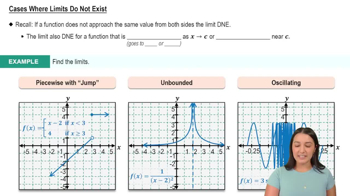
Cases Where Limits Do Not Exist

Indeterminate Forms

Indeterminate forms occur when a limit expression does not directly yield a clear value, such as 1^∞, 0^0, or ∞^0. Recognizing these forms helps in applying appropriate techniques like logarithms or L'Hôpital's Rule to find the limit.
Video consigliato:
Percorso guidato
6:20
Circles in General Form

Logarithmic Transformation for Limits

Taking the natural logarithm of a function can simplify limits involving powers by converting exponentiation into multiplication. This transformation often makes it easier to apply limit laws and L'Hôpital's Rule to evaluate complex expressions.
Video consigliato:
Percorso guidato
5:25
Intro to Transformations