Ch. 7 - Transcendental Functions
Hass - Thomas' Calculus 15th Edition
Hass15th EditionThomas' CalculusISBN: 9780137616077Non è quello che usi tu?Cambia libro di testo
Capitolo 7, Problema 7.6.139a

[Technology Exercise] In Exercises 139–141, find the domain and range of each composite function. Then graph the compositions on separate screens. Do the graphs make sense in each case? Give reasons for your answers. Comment on any differences you see.
139. a. y=arctan(tan x)

Guida verificata passo dopo passo
1
Identify the inner and outer functions in the composition. Here, the inner function is \(\tan x\) and the outer function is \(\arctan y\), where \(y = \tan x\).
Recall the domain and range of each function separately: \(\tan x\) has domain \(x \neq \frac{\pi}{2} + k\pi\), \(k \in \mathbb{Z}\), and range \((-\infty, \infty)\); \(\arctan x\) has domain \((-\infty, \infty)\) and range \(\left(-\frac{\pi}{2}, \frac{\pi}{2}\right)\).
Since \(\arctan\) is applied to \(\tan x\), the domain of the composite function \(y = \arctan(\tan x)\) is the domain of \(\tan x\), which excludes points where \(\tan x\) is undefined.
The range of the composite function is limited by the range of \(\arctan\), so \(y\) will lie in \(\left(-\frac{\pi}{2}, \frac{\pi}{2}\right)\).
Consider the behavior of \(\arctan(\tan x)\) over intervals where \(\tan x\) is continuous and increasing. The function essentially 'wraps' \(x\) back into the principal range of \(\arctan\), causing a periodic 'sawtooth' pattern. This explains why the graph repeats and why the range is restricted.

Risposta video verificata per un problema simile:

Questa soluzione video è stata consigliata dai nostri tutor come utile per risolvere questo problema.
Durata del video:
3m

Concetti chiave

Ecco i concetti essenziali che devi comprendere per rispondere correttamente alla domanda.

Composite Functions

A composite function is formed when one function is applied to the result of another, written as (f ∘ g)(x) = f(g(x)). Understanding how to combine functions and evaluate their outputs is essential for analyzing the domain and range of compositions.
Video consigliato:
3:48
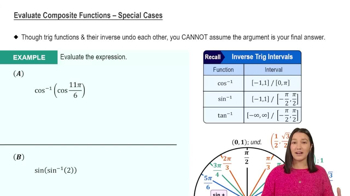
Evaluate Composite Functions - Special Cases

Domain and Range of Trigonometric and Inverse Trigonometric Functions

The domain is the set of input values for which a function is defined, and the range is the set of possible output values. For example, tan(x) is defined for all real x except odd multiples of π/2, while arctan(x) has a range of (-π/2, π/2). Knowing these restrictions helps determine the domain and range of their composition.
Video consigliato:
06:35
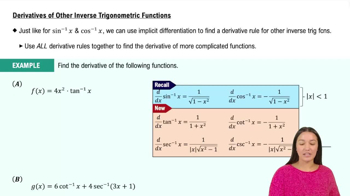
Derivatives of Other Inverse Trigonometric Functions

Graphing and Interpretation of Function Behavior

Graphing composite functions helps visualize their behavior, including periodicity, discontinuities, and range limitations. Comparing the graph of y = arctan(tan x) with the original functions reveals how the composition behaves and whether the outputs align with expected ranges.
Video consigliato:
Percorso guidato
5:53
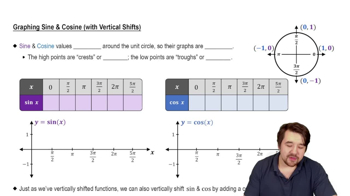
Graph of Sine and Cosine Function