Ch. 7 - Transcendental Functions
Hass - Thomas' Calculus 15th Edition
Hass15th EditionThomas' CalculusISBN: 9780137616077Non è quello che usi tu?Cambia libro di testo
Capitolo 7, Problema 7.5.75

Theory and Applications
L’Hôpital’s Rule does not help with the limits in Exercises 69–76. 
Try it—you just keep on cycling. Find the limits some other way.
75. lim (x → ∞) e^(x²) / (x e^x)

Guida verificata passo dopo passo
1
First, identify the form of the limit as \(x \to \infty\) for the expression \(\frac{e^{x^{2}}}{x e^{x}}\). Notice that the numerator grows like \(e^{x^{2}}\) and the denominator grows like \(x e^{x}\).
Recognize that \(e^{x^{2}}\) grows much faster than \(e^{x}\) as \(x\) becomes very large, since the exponent \(x^{2}\) grows faster than \(x\). This suggests the limit might be infinite, but we need to confirm rigorously.
Since L’Hôpital’s Rule cycles without resolving the limit, try rewriting the expression to compare growth rates more clearly. For example, write the expression as \(\frac{e^{x^{2}}}{x e^{x}} = \frac{e^{x^{2}}}{e^{x}} \cdot \frac{1}{x} = e^{x^{2} - x} \cdot \frac{1}{x}\).
Analyze the exponent in the exponential term: \(x^{2} - x\). As \(x \to \infty\), \(x^{2} - x\) also tends to infinity, so \(e^{x^{2} - x}\) grows without bound much faster than \(x\) grows in the denominator.
Conclude that since \(e^{x^{2} - x}\) dominates the \(\frac{1}{x}\) term, the entire expression grows without bound, and thus the limit tends to infinity.

Risposta video verificata per un problema simile:

Questa soluzione video è stata consigliata dai nostri tutor come utile per risolvere questo problema.
Durata del video:
2m

Concetti chiave

Ecco i concetti essenziali che devi comprendere per rispondere correttamente alla domanda.

Limits at Infinity

Limits at infinity describe the behavior of a function as the input grows without bound. Understanding how functions like exponentials and polynomials behave as x approaches infinity is crucial to evaluating such limits.
Video consigliato:
03:07
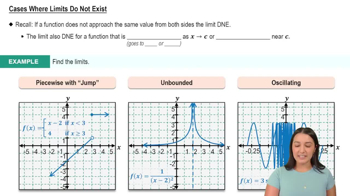
Cases Where Limits Do Not Exist

Growth Rates of Functions

Different functions grow at different rates; for example, exponential functions grow faster than polynomials. Comparing growth rates helps determine which part of a fraction dominates as x approaches infinity, guiding the evaluation of limits.
Video consigliato:
Percorso guidato
04:16
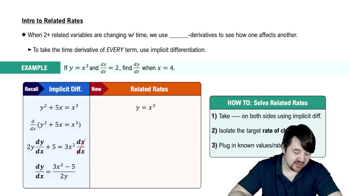
Intro To Related Rates

L’Hôpital’s Rule and Its Limitations

L’Hôpital’s Rule is used to evaluate indeterminate forms like 0/0 or ∞/∞ by differentiating numerator and denominator. However, it can fail or lead to cycles if repeated application does not simplify the limit, requiring alternative methods.
Video consigliato:
05:50
One-Sided Limits