Ch. 8 - Techniques of Integration
Hass - Thomas' Calculus 15th Edition
Hass15th EditionThomas' CalculusISBN: 9780137616077Non è quello che usi tu?Cambia libro di testo
Capitolo 8, Problema 8.4.59b

Consider the region bounded by the graphs of y = sin⁻¹(x), y = 0, and x = 1/2.
b. Find the centroid of the region.

Guida verificata passo dopo passo
1
Identify the region bounded by the curves: the inverse sine function \(y = \sin^{-1}(x)\), the line \(y = 0\), and the vertical line \(x = \frac{1}{2}\). This region lies between \(x = 0\) and \(x = \frac{1}{2}\) because \(\sin^{-1}(0) = 0\) and the lower boundary is \(y=0\).
Set up the formulas for the coordinates of the centroid \((\bar{x}, \bar{y})\) of a planar region bounded by curves. The centroid coordinates are given by: \(\displaystyle \bar{x} = \frac{1}{A} \int_a^b x \cdot f(x) \, dx\) and \(\displaystyle \bar{y} = \frac{1}{2A} \int_a^b [f(x)]^2 \, dx\), where \(f(x) = \sin^{-1}(x)\), \(a=0\), \(b=\frac{1}{2}\), and \(A\) is the area of the region.
Calculate the area \(A\) of the region using the integral: \(\displaystyle A = \int_0^{\frac{1}{2}} \sin^{-1}(x) \, dx\). This integral represents the area under the curve \(y = \sin^{-1}(x)\) from \(x=0\) to \(x=\frac{1}{2}\) above the \(x\)-axis.
Compute the integrals needed for the centroid coordinates: - For \(\bar{x}\), evaluate \(\int_0^{\frac{1}{2}} x \sin^{-1}(x) \, dx\). - For \(\bar{y}\), evaluate \(\int_0^{\frac{1}{2}} (\sin^{-1}(x))^2 \, dx\). These integrals may require integration by parts or substitution techniques.
Finally, substitute the values of the integrals and the area \(A\) into the centroid formulas: \(\displaystyle \bar{x} = \frac{1}{A} \int_0^{\frac{1}{2}} x \sin^{-1}(x) \, dx\) and \(\displaystyle \bar{y} = \frac{1}{2A} \int_0^{\frac{1}{2}} (\sin^{-1}(x))^2 \, dx\). This will give the coordinates of the centroid of the region.

Risposta video verificata per un problema simile:

Questa soluzione video è stata consigliata dai nostri tutor come utile per risolvere questo problema.
Durata del video:
11m

Concetti chiave

Ecco i concetti essenziali che devi comprendere per rispondere correttamente alla domanda.

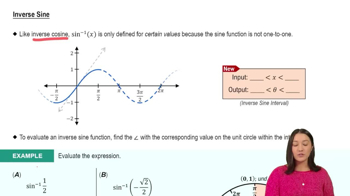
Inverse Sine Function (arcsin)

The inverse sine function, denoted as y = sin⁻¹(x), gives the angle whose sine is x. It is defined on the interval [-1, 1] with range [-π/2, π/2]. Understanding its graph and properties is essential to describe the region bounded by y = sin⁻¹(x), y = 0, and x = 1/2.
Video consigliato:
4:03
Inverse Sine

Centroid of a Plane Region

The centroid is the geometric center or 'balance point' of a plane region. It can be found using integrals that calculate the average x and y coordinates weighted by area. For regions bounded by curves, the centroid coordinates (x̄, ȳ) are found using formulas involving definite integrals of the bounding functions.
Video consigliato:
Percorso guidato
07:45
Area of Polar Regions

Definite Integrals for Area and Moments

Definite integrals compute the area under curves and moments about axes, which are necessary to find the centroid. The area integral is ∫ f(x) dx, while moments involve integrals like ∫ x f(x) dx and ∫ (1/2) [f(x)]² dx. Mastery of setting up and evaluating these integrals is crucial for solving centroid problems.
Video consigliato:
Percorso guidato
05:43
Definition of the Definite Integral