Ch. 8 - Techniques of Integration
Hass - Thomas' Calculus 15th Edition
Hass15th EditionThomas' CalculusISBN: 9780137616077Non è quello che usi tu?Cambia libro di testo
Capitolo 8, Problema 8.AAE.24

Finding surface area
Find the area of the surface generated by revolving the curve in Exercise 23 about the y-axis.

Guida verificata passo dopo passo
1
Identify the curve from Exercise 23. Since the problem references a previous exercise, first write down the explicit function \( y = f(x) \) or parametric equations given in that exercise.
Recall the formula for the surface area \( S \) generated by revolving a curve \( y = f(x) \) about the y-axis from \( x = a \) to \( x = b \): \[ S = \int_a^b 2\pi x \sqrt{1 + \left(\frac{dy}{dx}\right)^2} \, dx \] This formula uses the radius \( x \) (distance from the y-axis) and the arc length element.
Compute the derivative \( \frac{dy}{dx} \) of the function \( y = f(x) \). This is necessary to find the integrand's square root term.
Set up the integral by substituting \( x \), \( \frac{dy}{dx} \), and the limits of integration \( a \) and \( b \) into the surface area formula.
Evaluate the integral (or simplify it as much as possible) to express the surface area. If the integral is complicated, consider substitution or numerical methods, but do not compute the final value here.

Risposta video verificata per un problema simile:

Questa soluzione video è stata consigliata dai nostri tutor come utile per risolvere questo problema.
Durata del video:
4m

Concetti chiave

Ecco i concetti essenziali che devi comprendere per rispondere correttamente alla domanda.

Surface Area of Revolution

The surface area of a solid formed by revolving a curve around an axis is found using an integral formula. For revolution about the y-axis, the formula involves integrating 2π times the radius (distance from the y-axis) times the arc length differential. This captures the 'wrapped' surface created by the rotating curve.
Video consigliato:
09:07
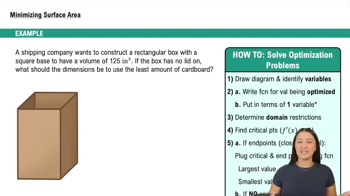
Example 1: Minimizing Surface Area

Parametric or Function Representation of Curves

To compute surface area, the curve must be expressed as a function or parametric equations. This allows calculation of derivatives and arc length elements. Understanding how to represent the curve from Exercise 23 is essential to set up the integral correctly.
Video consigliato:
Percorso guidato
06:49
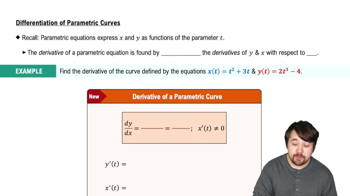
Differentiation of Parametric Curves

Arc Length Differential

The arc length differential, ds, measures an infinitesimal segment of the curve and is given by √(dx/dt)² + (dy/dt)² dt or √(1 + (dy/dx)²) dx. It is crucial for integrating along the curve to find surface area, as it accounts for the curve's shape and length.
Video consigliato:
Percorso guidato
06:29
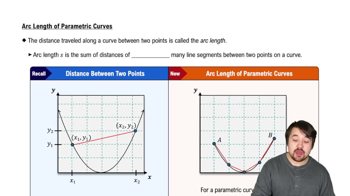
Arc Length of Parametric Curves