Ch. 8 - Techniques of Integration
Hass - Thomas' Calculus 15th Edition
Hass15th EditionThomas' CalculusISBN: 9780137616077Non è quello che usi tu?Cambia libro di testo
Capitolo 8, Problema 8.8.8

The integrals in Exercises 1–34 converge. Evaluate the integrals without using tables.
∫₀¹ dr / r^0.999

Guida verificata passo dopo passo
1
Identify the integral to be evaluated: \(\int_0^1 \frac{dr}{r^{0.999}}\).
Rewrite the integrand using exponent rules: \(\frac{1}{r^{0.999}} = r^{-0.999}\), so the integral becomes \(\int_0^1 r^{-0.999} \, dr\).
Recall the power rule for integration: For \(\int r^n \, dr\), where \(n \neq -1\), the antiderivative is \(\frac{r^{n+1}}{n+1} + C\).
Apply the power rule to the integral: \(\int_0^1 r^{-0.999} \, dr = \left[ \frac{r^{-0.999 + 1}}{-0.999 + 1} \right]_0^1 = \left[ \frac{r^{0.001}}{0.001} \right]_0^1\).
Evaluate the definite integral by substituting the limits: calculate \(\frac{1^{0.001}}{0.001} - \frac{0^{0.001}}{0.001}\), noting the behavior of \(r^{0.001}\) as \(r\) approaches 0.

Risposta video verificata per un problema simile:

Questa soluzione video è stata consigliata dai nostri tutor come utile per risolvere questo problema.
Durata del video:
3m

Concetti chiave

Ecco i concetti essenziali che devi comprendere per rispondere correttamente alla domanda.

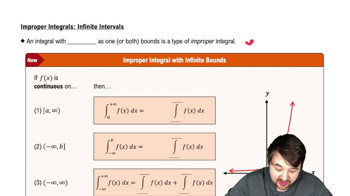
Improper Integrals

Improper integrals involve integrands that are unbounded or have infinite limits. When the integrand approaches infinity at a boundary, the integral is evaluated as a limit to determine convergence or divergence.
Video consigliato:
Percorso guidato
11:11
Improper Integrals: Infinite Intervals

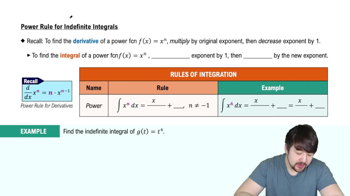
Power Rule for Integration

The power rule states that ∫x^n dx = (x^(n+1))/(n+1) + C for n ≠ -1. This rule is essential for integrating functions with variable exponents, allowing direct evaluation of integrals involving powers of the variable.
Video consigliato:
Percorso guidato
04:04
Power Rule for Indefinite Integrals

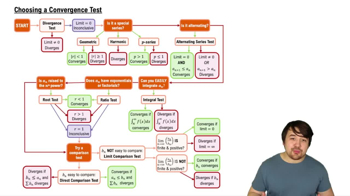
Convergence of Integrals with Singularities

When the integrand has a singularity (like r^(-0.999) near zero), determining if the integral converges requires analyzing the behavior near the singularity. If the integral's limit exists and is finite, the integral converges.
Video consigliato:
Percorso guidato
07:51
Choosing a Convergence Test