Ch. 8 - Techniques of Integration
Hass - Thomas' Calculus 15th Edition
Hass15th EditionThomas' CalculusISBN: 9780137616077Non è quello che usi tu?Cambia libro di testo
Capitolo 8, Problema 8.8.20

The integrals in Exercises 1–34 converge. Evaluate the integrals without using tables.
∫₀^∞ (16 tan⁻¹x dx) / (1 + x²)

Guida verificata passo dopo passo
1
Recognize that the integral is an improper integral with the upper limit approaching infinity, so we will consider the limit as the upper bound tends to infinity: \(\int_0^{\infty} \frac{16 \tan^{-1}(x)}{1 + x^2} \, dx = \lim_{t \to \infty} \int_0^t \frac{16 \tan^{-1}(x)}{1 + x^2} \, dx\).
Identify a suitable substitution or integration technique. Notice that the derivative of \(\tan^{-1}(x)\) is \(\frac{1}{1 + x^2}\), which appears in the denominator. This suggests using integration by parts with \(u = \tan^{-1}(x)\) and \(dv = \frac{16}{1 + x^2} dx\).
Set up integration by parts: let \(u = \tan^{-1}(x)\) so that \(du = \frac{1}{1 + x^2} dx\), and let \(dv = \frac{16}{1 + x^2} dx\) so that \(v = 16 \tan^{-1}(x)\) (since the integral of \(\frac{1}{1 + x^2}\) is \(\tan^{-1}(x)\)).
Apply the integration by parts formula: \(\int u \, dv = uv - \int v \, du\). Substitute the expressions for \(u\), \(v\), \(du\), and \(dv\) to rewrite the integral.
Simplify the resulting expression and evaluate the limit as \(t \to \infty\). Use the known limits of \(\tan^{-1}(x)\) as \(x\) approaches infinity and zero to find the value of the integral.

Risposta video verificata per un problema simile:

Questa soluzione video è stata consigliata dai nostri tutor come utile per risolvere questo problema.
Durata del video:
8m

Concetti chiave

Ecco i concetti essenziali che devi comprendere per rispondere correttamente alla domanda.

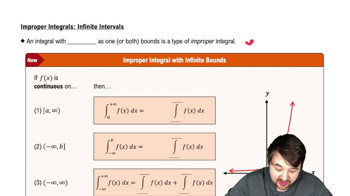
Improper Integrals

Improper integrals involve integration over an infinite interval or integrands with infinite discontinuities. To evaluate them, one typically takes limits to handle the infinite bounds or singularities, ensuring the integral converges to a finite value.
Video consigliato:
Percorso guidato
11:11
Improper Integrals: Infinite Intervals

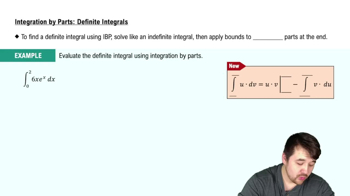
Integration by Parts

Integration by parts is a technique based on the product rule for differentiation. It transforms the integral of a product of functions into simpler integrals, often making complex integrals more manageable, especially when one function simplifies upon differentiation.
Video consigliato:
Percorso guidato
06:18
Integration by Parts for Definite Integrals

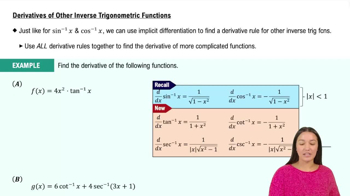
Inverse Trigonometric Functions and Their Derivatives

Inverse trigonometric functions like arctan(x) have well-known derivatives, e.g., d/dx [arctan(x)] = 1/(1 + x²). Recognizing these derivatives helps in integration, especially when the integrand includes inverse trig functions combined with rational expressions.
Video consigliato:
06:35
Derivatives of Other Inverse Trigonometric Functions