Ch. 8 - Techniques of Integration
Hass - Thomas' Calculus 15th Edition
Hass15th EditionThomas' CalculusISBN: 9780137616077Non è quello che usi tu?Cambia libro di testo
Capitolo 8, Problema 8.8.24

The integrals in Exercises 1–34 converge. Evaluate the integrals without using tables.
∫₋∞^∞ 2x e^(−x²) dx

Guida verificata passo dopo passo
1
Recognize that the integral is an improper integral over the entire real line, from \(-\infty\) to \(\infty\), of the function \(2x e^{-x^{2}}\).
Note that the integrand \(2x e^{-x^{2}}\) is an odd function because \(2(-x) e^{-(-x)^{2}} = -2x e^{-x^{2}}\), which is the negative of the original function.
Recall that the integral of any odd function over symmetric limits \([-a, a]\) is zero, provided the integral converges.
Since the limits are \(-\infty\) to \(\infty\), which are symmetric about zero, and the function is odd and integrable, the integral evaluates to zero.
Therefore, without performing any integration by parts or substitution, conclude that the value of the integral is zero due to the symmetry of the integrand.

Risposta video verificata per un problema simile:

Questa soluzione video è stata consigliata dai nostri tutor come utile per risolvere questo problema.
Durata del video:
7m

Concetti chiave

Ecco i concetti essenziali che devi comprendere per rispondere correttamente alla domanda.

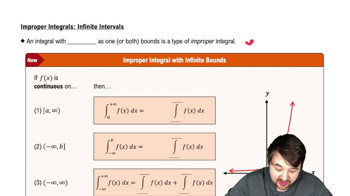
Improper Integrals

Improper integrals involve integration over infinite limits or integrands with infinite discontinuities. To evaluate them, one typically takes limits of definite integrals as the bounds approach infinity. Understanding convergence is crucial to ensure the integral has a finite value.
Video consigliato:
Percorso guidato
11:11
Improper Integrals: Infinite Intervals

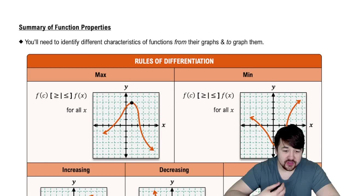
Properties of Even and Odd Functions

Even functions satisfy f(−x) = f(x), and odd functions satisfy f(−x) = −f(x). When integrating over symmetric limits (−a to a), the integral of an odd function is zero, while the integral of an even function is twice the integral from 0 to a. Recognizing function symmetry simplifies evaluation.
Video consigliato:
Percorso guidato
06:21
Properties of Functions

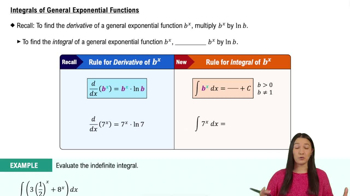
Integration of Exponential Functions with Quadratic Exponents

Integrals involving e^(−x²) are common in calculus and probability. While the integral of e^(−x²) has no elementary antiderivative, multiplying by x or other polynomials can allow evaluation using substitution or recognizing derivative forms. This helps in solving integrals like ∫ x e^(−x²) dx.
Video consigliato:
05:11
Integrals of General Exponential Functions