
Ch. 8 - Techniques of Integration
Hass - Thomas' Calculus 15th Edition
Hass15th EditionThomas' CalculusISBN: 9780137616077Non è quello che usi tu?Cambia libro di testo
Capitolo 8, Problema 8.2.80

Use the formula ∫ f⁻¹(x) dx = x f⁻¹(x) - ∫ f(y) dy, y = f⁻¹(x)
To evaluate the integrals in Exercises 77-80. Express your answers in terms of x.
∫ log₂ x dx

Guida verificata passo dopo passo
1
Identify the function inside the integral: here, we have \( \int \log_2 x \, dx \). Recognize that \( \log_2 x \) is the inverse of the exponential function \( f(y) = 2^y \), since \( y = \log_2 x \) implies \( x = 2^y \).
Recall the formula for integrating an inverse function: \[ \int f^{-1}(x) \, dx = x f^{-1}(x) - \int f(y) \, dy, \quad \text{where } y = f^{-1}(x). \] In this problem, \( f^{-1}(x) = \log_2 x \) and \( f(y) = 2^y \).
Substitute into the formula: \[ \int \log_2 x \, dx = x \log_2 x - \int 2^y \, dy, \quad \text{with } y = \log_2 x. \] This breaks the original integral into two parts: the product \( x \log_2 x \) and the integral of \( 2^y \) with respect to \( y \).
Evaluate the integral \( \int 2^y \, dy \). Recall that the integral of an exponential function with base \( a \) is \( \int a^y \, dy = \frac{a^y}{\ln a} + C \). So, \[ \int 2^y \, dy = \frac{2^y}{\ln 2} + C. \]
Finally, substitute back \( y = \log_2 x \) into the expression to write the answer entirely in terms of \( x \). This will give you the integral \( \int \log_2 x \, dx \) expressed in terms of \( x \).

Risposta video verificata per un problema simile:

Questa soluzione video è stata consigliata dai nostri tutor come utile per risolvere questo problema.
Durata del video:
9m

Concetti chiave

Ecco i concetti essenziali che devi comprendere per rispondere correttamente alla domanda.

Inverse Function Integration Formula

This formula relates the integral of an inverse function f⁻¹(x) to an expression involving x, f⁻¹(x), and the integral of the original function f(y). It is useful for integrating inverse functions by transforming the problem into integrals of the original function.
Video consigliato:
04:51
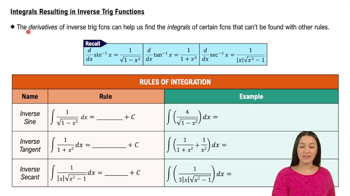
Integrals Resulting in Inverse Trig Functions

Properties of Logarithmic Functions

Understanding the logarithm base change and its derivative is essential. For log₂(x), it can be rewritten using natural logs as log₂(x) = ln(x)/ln(2), which simplifies differentiation and integration by converting to natural logarithms.
Video consigliato:
Percorso guidato
06:21
Properties of Functions

Integration by Parts

Integration by parts is a technique based on the product rule for differentiation, useful for integrating products of functions. It is often applied to integrals involving logarithms, where one function is chosen to simplify upon differentiation.
Video consigliato:
Percorso guidato
06:18
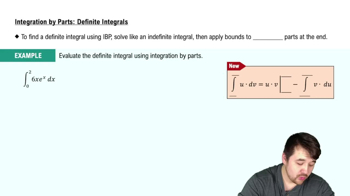
Integration by Parts for Definite Integrals