Ch. 8 - Techniques of Integration
Hass - Thomas' Calculus 15th Edition
Hass15th EditionThomas' CalculusISBN: 9780137616077Non è quello che usi tu?Cambia libro di testo
Capitolo 8, Problema 8.PE.63

Which of the improper integrals in Exercises 63–68 converge and which diverge?
∫ from 6 to ∞ of (1 / √(θ² + 1)) dθ

Guida verificata passo dopo passo
1
Identify the type of improper integral: Since the upper limit of integration is infinity, this is an improper integral of the form \(\int_{6}^{\infty} \frac{1}{\sqrt{\theta^{2} + 1}} \, d\theta\).
Set up the integral as a limit: Rewrite the integral as \(\lim_{t \to \infty} \int_{6}^{t} \frac{1}{\sqrt{\theta^{2} + 1}} \, d\theta\) to handle the infinite upper bound.
Find the antiderivative: Recognize that the integral of \(\frac{1}{\sqrt{\theta^{2} + 1}}\) with respect to \(\theta\) is \(\sinh^{-1}(\theta)\) or equivalently \(\ln\left(\theta + \sqrt{\theta^{2} + 1}\right)\).
Evaluate the definite integral from 6 to \(t\): Substitute the limits into the antiderivative to get \(\sinh^{-1}(t) - \sinh^{-1}(6)\) or \(\ln\left(t + \sqrt{t^{2} + 1}\right) - \ln\left(6 + \sqrt{36 + 1}\right)\).
Take the limit as \(t\) approaches infinity: Analyze \(\lim_{t \to \infty} \sinh^{-1}(t)\) or \(\lim_{t \to \infty} \ln\left(t + \sqrt{t^{2} + 1}\right)\) to determine if the integral converges (finite limit) or diverges (infinite limit).

Risposta video verificata per un problema simile:

Questa soluzione video è stata consigliata dai nostri tutor come utile per risolvere questo problema.
Durata del video:
4m

Concetti chiave

Ecco i concetti essenziali che devi comprendere per rispondere correttamente alla domanda.

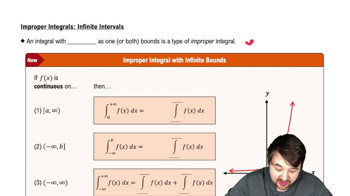
Improper Integrals

Improper integrals involve integration over an infinite interval or integrands with infinite discontinuities. To evaluate them, limits are used to approach the problematic points, determining if the integral converges to a finite value or diverges.
Video consigliato:
Percorso guidato
11:11
Improper Integrals: Infinite Intervals

Convergence and Divergence of Integrals

An improper integral converges if its limit exists and is finite; otherwise, it diverges. Testing convergence often involves comparing the integrand to a known function with established integral behavior over infinite intervals.
Video consigliato:
Percorso guidato
05:44
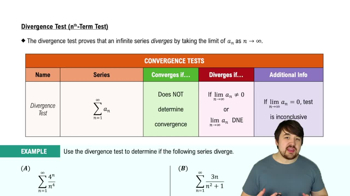
Divergence Test (nth Term Test)

Comparison Test for Improper Integrals

The comparison test helps determine convergence by comparing the given integrand to a simpler function that bounds it above or below. If the simpler function's integral converges and bounds the original integrand, the original integral also converges.
Video consigliato:
Percorso guidato
11:11
Improper Integrals: Infinite Intervals