Ch. 9 - First-Order Differential Equations
Hass - Thomas' Calculus 15th Edition
Hass15th EditionThomas' CalculusISBN: 9780137616077Non è quello che usi tu?Cambia libro di testo
Capitolo 9, Problema 9.1.8

Integral Equations
In Exercises 7–12, write an equivalent first-order differential equation
and initial condition for y.


y = ∫₁ ͯ 1/t dt

Guida verificata passo dopo passo
1
Identify the given integral equation: \(y = \int_{1}^{x} \frac{1}{t} \, dt\).
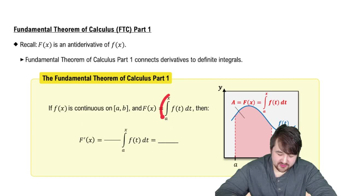
Recall the Fundamental Theorem of Calculus, which states that if \(y = \int_{a}^{x} f(t) \, dt\), then \(\frac{dy}{dx} = f(x)\).
Apply the theorem to differentiate both sides with respect to \(x\): \(\frac{dy}{dx} = \frac{1}{x}\).
Write the equivalent first-order differential equation: \(\frac{dy}{dx} = \frac{1}{x}\).
Determine the initial condition by evaluating \(y\) at the lower limit of integration: since \(y = \int_{1}^{x} \frac{1}{t} \, dt\), then \(y(1) = 0\).

Risposta video verificata per un problema simile:

Questa soluzione video è stata consigliata dai nostri tutor come utile per risolvere questo problema.
Durata del video:
2m

Concetti chiave

Ecco i concetti essenziali che devi comprendere per rispondere correttamente alla domanda.

Fundamental Theorem of Calculus

This theorem connects differentiation and integration, stating that if a function is defined as an integral with a variable upper limit, its derivative is the integrand evaluated at that limit. It allows converting integral expressions into differential equations by differentiating both sides.
Video consigliato:
Percorso guidato
06:11
Fundamental Theorem of Calculus Part 1

Differentiation of Integral Functions

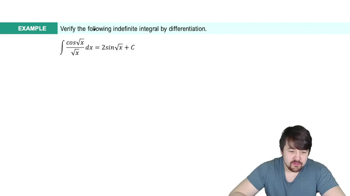
When a function is defined as an integral with a variable limit, differentiating it requires applying the Leibniz rule or the Fundamental Theorem of Calculus. This process transforms the integral equation into a differential equation involving the original function and its derivative.
Video consigliato:
Percorso guidato
04:22
Integrals Resulting in Basic Trig Functions Example 1

Initial Conditions in Differential Equations

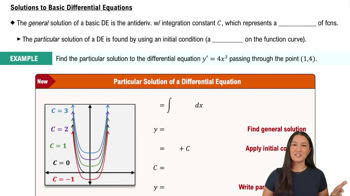
Initial conditions specify the value of the unknown function at a particular point, ensuring a unique solution to a differential equation. For integral-defined functions, the initial condition often comes from evaluating the integral at the lower limit.
Video consigliato:
04:00
Solutions to Basic Differential Equations