Ch. 9 - First-Order Differential Equations
Hass - Thomas' Calculus 15th Edition
Hass15th EditionThomas' CalculusISBN: 9780137616077Non è quello che usi tu?Cambia libro di testo
Capitolo 9, Problema 9.2.22a

Solve the following initial value problem for u as a function of t:


du/dt + (k/m) u = 0 (k and m positive constants), u(0) = u₀


a. as a first-order linear equation.

Guida verificata passo dopo passo
1
Recognize that the given differential equation is a first-order linear ordinary differential equation of the form \(\frac{du}{dt} + \frac{k}{m} u = 0\), where \(k\) and \(m\) are positive constants.
Identify the integrating factor \(\mu(t)\), which is given by \(\mu(t) = e^{\int P(t) \, dt}\), where \(P(t)\) is the coefficient of \(u\) in the equation. Here, \(P(t) = \frac{k}{m}\), so calculate \(\mu(t) = e^{\int \frac{k}{m} \, dt} = e^{\frac{k}{m} t}\).
Multiply both sides of the differential equation by the integrating factor \(\mu(t)\) to obtain \(e^{\frac{k}{m} t} \frac{du}{dt} + e^{\frac{k}{m} t} \frac{k}{m} u = 0\). This simplifies to \(\frac{d}{dt} \left( e^{\frac{k}{m} t} u \right) = 0\) because the left side is the derivative of the product \(e^{\frac{k}{m} t} u\).
Integrate both sides with respect to \(t\) to get \(e^{\frac{k}{m} t} u = C\), where \(C\) is the constant of integration.
Solve for \(u(t)\) by dividing both sides by \(e^{\frac{k}{m} t}\), yielding \(u(t) = C e^{-\frac{k}{m} t}\). Then, apply the initial condition \(u(0) = u_0\) to find \(C = u_0\), so the solution is \(u(t) = u_0 e^{-\frac{k}{m} t}\).

Risposta video verificata per un problema simile:

Questa soluzione video è stata consigliata dai nostri tutor come utile per risolvere questo problema.
Durata del video:
4m

Concetti chiave

Ecco i concetti essenziali che devi comprendere per rispondere correttamente alla domanda.

First-Order Linear Differential Equations

A first-order linear differential equation has the form du/dt + P(t)u = Q(t). It can be solved using an integrating factor, which simplifies the equation into an exact derivative, allowing integration to find the solution. Recognizing this form is essential for solving the given problem.
Video consigliato:
07:39
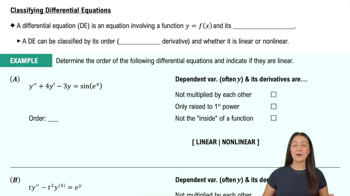
Classifying Differential Equations

Integrating Factor Method

The integrating factor is a function, typically e^(∫P(t)dt), used to multiply both sides of a linear differential equation. This transforms the left side into the derivative of a product, enabling straightforward integration. Applying this method helps solve the equation du/dt + (k/m)u = 0.
Video consigliato:
07:33
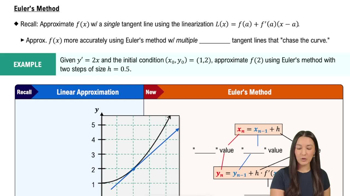
Euler's Method

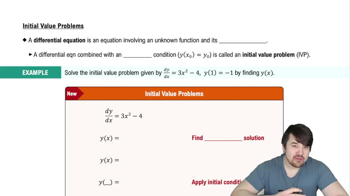
Initial Value Problems

An initial value problem specifies the value of the unknown function at a particular point, here u(0) = u₀. This condition allows determination of the constant of integration after solving the differential equation, ensuring a unique solution that fits the given initial state.
Video consigliato:
Percorso guidato
05:03
Initial Value Problems