Ch. 9 - First-Order Differential Equations
Hass - Thomas' Calculus 15th Edition
Hass15th EditionThomas' CalculusISBN: 9780137616077Non è quello che usi tu?Cambia libro di testo
Capitolo 9, Problema 9.AAE.5

Solve the homogeneous equations in Exercises 5–10. First put the equation in the form of a homogeneous equation.


(x²+y²)dx + xy dy = 0

Guida verificata passo dopo passo
1
Identify the given differential equation: \( (x^{2} + y^{2}) \, dx + x y \, dy = 0 \). Our goal is to rewrite it in the form \( M(x,y) \, dx + N(x,y) \, dy = 0 \) and check if it is homogeneous.
Recall that a function \(f(x,y)\) is homogeneous of degree \(n\) if \(f(tx, ty) = t^{n} f(x,y)\) for all \(t\). Check the degrees of \(M(x,y) = x^{2} + y^{2}\) and \(N(x,y) = x y\) to confirm homogeneity.
Since \(M(x,y)\) and \(N(x,y)\) are both homogeneous functions of degree 2, the differential equation is homogeneous. Next, use the substitution \(v = \frac{y}{x}\) to reduce the equation to a separable form.
Express \(y\) as \(v x\), then compute \(dy = v \, dx + x \, dv\). Substitute \(y\) and \(dy\) into the original equation to rewrite it entirely in terms of \(x\), \(v\), and \(dv\).
After substitution, simplify the resulting expression and separate variables to obtain an equation involving \(v\) and \(x\) that can be integrated to find the implicit solution.

Risposta video verificata per un problema simile:

Questa soluzione video è stata consigliata dai nostri tutor come utile per risolvere questo problema.
Durata del video:
9m

Concetti chiave

Ecco i concetti essenziali che devi comprendere per rispondere correttamente alla domanda.

Homogeneous Differential Equations

A differential equation is homogeneous if it can be expressed so that all terms are of the same degree when variables are scaled. Typically, it can be written as M(x,y)dx + N(x,y)dy = 0 where M and N are homogeneous functions of the same degree. Recognizing this form allows the use of substitution methods to simplify the equation.
Video consigliato:
07:39
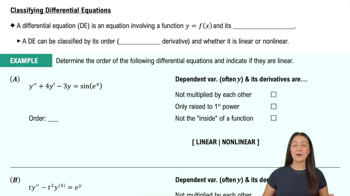
Classifying Differential Equations

Substitution Method (y = vx or x = vy)

To solve homogeneous equations, the substitution y = vx (or x = vy) is used to reduce the equation to a separable form. This substitution leverages the homogeneity by expressing y in terms of x and a new variable v, simplifying the differential equation into one involving v and x only, which is easier to solve.
Video consigliato:
06:30
Disk Method Using y-Axis

Separable Differential Equations

After substitution, the resulting equation often becomes separable, meaning it can be written as g(v) dv = h(x) dx. This allows integration of each side independently. Understanding how to separate variables and integrate is essential to find the general solution of the original differential equation.
Video consigliato:
06:06
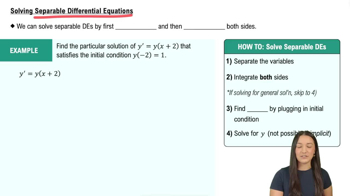
Solving Separable Differential Equations