Skip to main content
Cell Biology
Il mio corso
Impara
Preparazione agli esami
AI Tutor
Guide di studio
Flashcard
Esplora
Prova l'app
Il mio corso
Impara
Preparazione agli esami
AI Tutor
Guide di studio
Flashcard
Esplora
Prova l'app
Indietro
Carcinogens definitions
Puoi toccare per girare la carta.
Carcinogen
Puoi toccare per girare la carta.
👆
Carcinogen
Substance or molecule capable of inducing DNA damage, increasing the risk of cancer development in cells.
Avanzamenti del tracciato
I pulsanti di controllo sono stati cambiati in modalità "navigazione".
1/14
Flashcard correlate
Pratica correlata
Video consigliati
Carcinogens quiz #1
Carcinogens
10 Termini
Carcinogens
20. Cancer
7 Problemi
Argomento
Tumor Viruses
20. Cancer
7 Problemi
Argomento
20. Cancer - Part 1 of 2
3 Argomenti
9 Problemi
Capitolo
20. Cancer - Part 2 of 2
3 Argomenti
9 Problemi
Capitolo
VideoThumbView.guidedCourse
03:19
Carcinogens
264
views
2
rank
Termini in questo insieme (14)
Nascondere definizioni
Carcinogen
Substance or molecule capable of inducing DNA damage, increasing the risk of cancer development in cells.
Initiator
Agent that directly interacts with DNA, causing mutations that can start the process of cancer formation.
Promoter
Factor that encourages cancerous transformation in cells already containing DNA mutations, without causing mutations itself.
DNA Damage
Alteration to genetic material, such as breaks or modifications, that can disrupt normal cell function and lead to cancer.
Mutation
Permanent change in the DNA sequence, potentially leading to abnormal cell behavior and cancer.
DNA Repair System
Cellular mechanisms responsible for correcting DNA errors; deficiencies here can increase cancer risk.
Telomere Shortening
Progressive loss of protective chromosome ends, which can contribute to genomic instability and cancer.
Viral Genome Integration
Process where viral DNA becomes part of the host cell's genome, potentially disrupting normal gene regulation.
Tumor Promoter
Non-mutagenic substance that enhances the proliferation of cells with pre-existing mutations.
Tobacco
Widely recognized carcinogen that can directly damage cellular DNA, significantly increasing cancer risk.
Human Papillomavirus
Virus capable of integrating its genetic material into host cells, contributing to cancer development.
Hepatitis B
Virus associated with increased cancer risk due to its potential to alter host cell DNA.
Hepatitis C
Virus linked to cancer through mechanisms involving chronic infection and genetic disruption.
Lifestyle Choices
Behaviors such as diet and exercise that can influence an individual's overall cancer risk.
 IndietroIndietro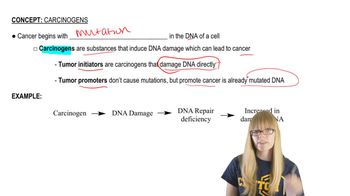
 03:19
03:19