Skip to main content
Cell Biology
Il mio corso
Impara
Preparazione agli esami
AI Tutor
Guide di studio
Flashcard
Esplora
Prova l'app
Il mio corso
Impara
Preparazione agli esami
AI Tutor
Guide di studio
Flashcard
Esplora
Prova l'app
Indietro
DNA Repair and Recombination definitions
Puoi toccare per girare la carta.
Depurination
Puoi toccare per girare la carta.
👆
Depurination
Loss of purine bases from DNA, creating missing spots in the double helix and potentially leading to mutations if unrepaired.
Avanzamenti del tracciato
I pulsanti di controllo sono stati cambiati in modalità "navigazione".
1/17
Flashcard correlate
Pratica correlata
Video consigliati
DNA Repair and Recombination quiz #1
DNA Repair and Recombination
10 Termini
DNA Repair and Recombination
16. Cell Division
7 Problemi
Argomento
Mitosis
16. Cell Division
7 Problemi
Argomento
16. Cell Division - Part 1 of 2
5 Argomenti
14 Problemi
Capitolo
16. Cell Division - Part 2 of 2
5 Argomenti
13 Problemi
Capitolo
VideoThumbView.guidedCourse
03:52
Repair Mechanisms
477
views
7
rank
VideoThumbView.guidedCourse
02:51
DNA Damage
504
views
5
rank
3
comments
VideoThumbView.guidedCourse
13:52
Homologous Recombination
764
views
7
rank
1
comments
Termini in questo insieme (17)
Nascondere definizioni
Depurination
Loss of purine bases from DNA, creating missing spots in the double helix and potentially leading to mutations if unrepaired.
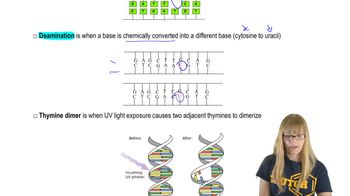
Deamination
Chemical conversion of a DNA base into a different base, such as cytosine turning into uracil, altering genetic information.
Thymine Dimer
Covalent linkage of adjacent thymine bases, usually caused by UV light, distorting the DNA helix and blocking replication.
Double Strand Break
Severing of both DNA strands, a severe form of damage that can lead to cell death if not properly repaired.
Mismatch Repair
Correction system that detects and fixes base-pairing errors by recognizing distortions in the DNA helix after replication.
Base Excision Repair
Repair pathway that removes chemically damaged bases, often using DNA glycosylase to excise and replace single nucleotides.
Nucleotide Excision Repair
Mechanism that removes bulky DNA lesions, such as thymine dimers, by excising a segment of the strand and filling the gap.
Non-Homologous End Joining
Repair process that directly joins broken DNA ends, often resulting in loss of genetic material at the break site.
Homologous Recombination
Accurate repair of double strand breaks using an undamaged homologous chromosome as a template, preserving genetic information.
Endonuclease
Enzyme that cuts DNA internally, removing damaged sections to create single-stranded regions necessary for repair.
RecA Protein
Stabilizing factor that binds single-stranded DNA during repair, preventing degradation and facilitating strand invasion.
Strand Invasion
Process where a single-stranded DNA segment invades a homologous DNA duplex, pairing with its complementary sequence.
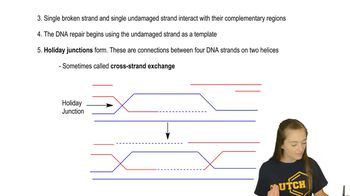
Holiday Junction
Cross-shaped DNA structure formed during homologous recombination, where strands from homologous chromosomes are exchanged.
Branch Migration
Movement of the crossover point in a Holiday Junction, allowing extension of the repaired DNA region during recombination.
Crossover
Exchange of genetic material between homologous chromosomes beyond the damaged area, increasing genetic diversity.
Dissolution
Unwinding of Holiday Junctions without cutting, resulting in repair without exchange of additional genetic material.
Resolution
Cleavage of Holiday Junctions, often leading to crossover and exchange of genetic material between chromosomes.
 IndietroIndietro
 03:52
03:52