Skip to main content
Cell Biology
Il mio corso
Impara
Preparazione agli esami
AI Tutor
Guide di studio
Flashcard
Esplora
Prova l'app
Il mio corso
Impara
Preparazione agli esami
AI Tutor
Guide di studio
Flashcard
Esplora
Prova l'app
Indietro
Energy Sources and Generation definitions
Puoi toccare per girare la carta.
Entropy
Puoi toccare per girare la carta.
👆
Entropy
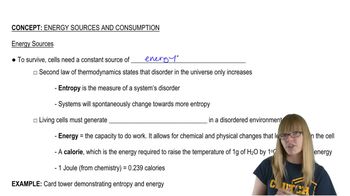
A measure of system disorder, reflecting the natural tendency for systems to become more disorganized over time.
Avanzamenti del tracciato
I pulsanti di controllo sono stati cambiati in modalità "navigazione".
1/15
Flashcard correlate
Pratica correlata
Video consigliati
Energy Sources and Generation quiz #1
Energy Sources and Generation
10 Termini
Energy Sources and Generation
3. Energy
7 Problemi
Argomento
Gibbs Free Energy and Equilibrium
3. Energy
6 Problemi
Argomento
3. Energy - Part 1 of 2
4 Argomenti
9 Problemi
Capitolo
3. Energy - Part 2 of 2
3 Argomenti
8 Problemi
Capitolo
VideoThumbView.guidedCourse
04:45
Energy Consumption
706
views
12
rank
VideoThumbView.guidedCourse
14:44
Energy Sources
1020
views
19
rank
2
comments
Termini in questo insieme (15)
Nascondere definizioni
Entropy
A measure of system disorder, reflecting the natural tendency for systems to become more disorganized over time.
Potential Energy
Stored energy, such as that found in chemical bonds or concentration gradients, available for future use.
Kinetic Energy
Energy associated with motion, including heat, light, and moving electrons within cells.
Calorie
A unit measuring the energy required to raise the temperature of 1 gram of water by 1 degree Celsius.
Joule
A unit of energy commonly used in chemistry, equivalent to 0.239 calories.
Membrane Concentration Gradient
A difference in molecule concentration across a membrane, representing stored energy until movement occurs.
Phototroph
An organism that converts light energy into chemical energy through photosynthesis.
Chemotroph
An organism that derives usable energy from organic nutrients, often releasing carbon dioxide and water.
Metabolism
The sum of all chemical reactions in a cell, encompassing both breakdown and synthesis processes.
Catabolism
The set of metabolic pathways that break down food into smaller molecules, releasing energy.
Anabolism
The set of metabolic pathways that synthesize complex molecules from simpler ones, requiring energy input.
Enzyme
A protein that accelerates metabolic reactions, facilitating both breakdown and synthesis in cells.
Oxidation
A process involving the removal of electrons from an atom or molecule, typically releasing energy.
Reduction
A process involving the addition of electrons to an atom or molecule, usually requiring energy input.
First Law of Thermodynamics
A principle stating that energy cannot be created or destroyed, only transformed between forms.
 IndietroIndietro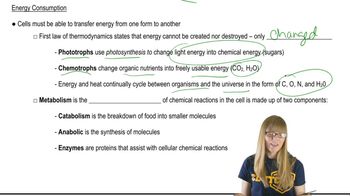
 04:45
04:45