Skip to main content
Cell Biology
Il mio corso
Impara
Preparazione agli esami
AI Tutor
Guide di studio
Flashcard
Esplora
Prova l'app
Il mio corso
Impara
Preparazione agli esami
AI Tutor
Guide di studio
Flashcard
Esplora
Prova l'app
Indietro
Enzyme Inhibitors quiz
Puoi toccare per girare la carta.
What is the main function of enzyme inhibitors?
Puoi toccare per girare la carta.
👆
What is the main function of enzyme inhibitors?
Enzyme inhibitors decrease enzymatic activity, slowing down or stopping reactions as needed.
Avanzamenti del tracciato
I pulsanti di controllo sono stati cambiati in modalità "navigazione".
1/15
Flashcard correlate
Pratica correlata
Video consigliati
Enzyme Inhibitors definitions
Enzyme Inhibitors
13 Termini
Enzyme Inhibitors
3. Energy
7 Problemi
Argomento
Enzyme Kinetics
3. Energy
7 Problemi
Argomento
3. Energy - Part 1 of 2
4 Argomenti
9 Problemi
Capitolo
3. Energy - Part 2 of 2
3 Argomenti
8 Problemi
Capitolo
VideoThumbView.guidedCourse
04:08
Enzyme Inhibition
537
views
6
rank
Termini in questo insieme (15)
Nascondere definizioni
What is the main function of enzyme inhibitors?
Enzyme inhibitors decrease enzymatic activity, slowing down or stopping reactions as needed.
What are the two main types of enzyme inhibitors?
The two main types are reversible inhibitors and irreversible inhibitors.
How do irreversible inhibitors interact with enzymes?
Irreversible inhibitors bind tightly to enzymes through covalent bonds, permanently disabling their function.
Give an example of an irreversible enzyme inhibitor.
Nerve gas is an example of an irreversible enzyme inhibitor.
How do reversible inhibitors bind to enzymes?
Reversible inhibitors bind weakly to enzymes through non-covalent interactions, allowing their effects to be reversed.
What are the two types of reversible enzyme inhibitors?
The two types are competitive inhibitors and non-competitive (allosteric) inhibitors.
How do competitive inhibitors affect enzyme activity?
Competitive inhibitors compete with the substrate for the enzyme's active site, preventing substrate binding.
Where do non-competitive inhibitors bind on the enzyme?
Non-competitive inhibitors bind to a different site on the enzyme, not the active site.
What is another name for non-competitive inhibitors?
Non-competitive inhibitors are also called allosteric inhibitors.
How do non-competitive inhibitors prevent substrate interaction?
They alter the shape of the enzyme's active site, so the substrate can no longer bind effectively.
Can the effects of irreversible inhibitors be reversed?
No, the effects of irreversible inhibitors cannot be reversed because they bind permanently.
Why are enzyme inhibitors important for cells?
They help regulate cellular chemical reactions by controlling when enzymes are active or inactive.
What happens to the enzyme after an irreversible inhibitor binds?
The enzyme is permanently inactivated and cannot catalyze reactions anymore.
How can the effects of reversible inhibitors be undone?
Their effects can be undone because the weak, non-covalent bonds can be broken, releasing the inhibitor.
What is the main difference between competitive and non-competitive inhibition?
Competitive inhibitors block the active site, while non-competitive inhibitors bind elsewhere and change the active site's shape.
 IndietroIndietro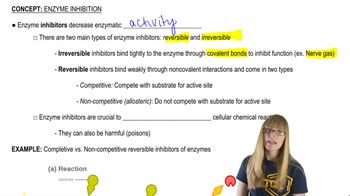
 04:08
04:08