Skip to main content
Cell Biology
Il mio corso
Impara
Preparazione agli esami
AI Tutor
Guide di studio
Flashcard
Esplora
Prova l'app
Il mio corso
Impara
Preparazione agli esami
AI Tutor
Guide di studio
Flashcard
Esplora
Prova l'app
Indietro
Principles of Transmembrane Transport definitions
Puoi toccare per girare la carta.
Semipermeability
Puoi toccare per girare la carta.
👆
Semipermeability
Property allowing selective passage of certain molecules while restricting others, enabling regulation of cellular exchange with the environment.
Avanzamenti del tracciato
I pulsanti di controllo sono stati cambiati in modalità "navigazione".
1/14
Flashcard correlate
Pratica correlata
Video consigliati
Principles of Transmembrane Transport quiz #1
Principles of Transmembrane Transport
40 Termini
Principles of Transmembrane Transport quiz #2
Principles of Transmembrane Transport
34 Termini
Principles of Transmembrane Transport
9. Transport Across Membranes
7 Problemi
Argomento
Passive Transport: Diffusion and Osmosis
9. Transport Across Membranes
7 Problemi
Argomento
9. Transport Across Membranes
5 Argomenti
15 Problemi
Capitolo
VideoThumbView.guidedCourse
03:37
Membranes and Gradients
1221
views
26
rank
3
comments
VideoThumbView.guidedCourse
03:11
Passive and Active Transport
1085
views
23
rank
1
comments
Termini in questo insieme (14)
Nascondere definizioni
Semipermeability
Property allowing selective passage of certain molecules while restricting others, enabling regulation of cellular exchange with the environment.
Concentration Gradient
Difference in molecule concentration across a membrane, creating a driving force for movement from high to low concentration.
Electrical Potential
Charge difference across a membrane, resulting from unequal distribution of ions on either side.
Electrochemical Potential
Combined effect of concentration gradient and electrical potential, determining the overall driving force for ion movement.
Membrane Potential
Net difference between concentration gradient and electrical potential, reflecting the overall charge difference across the membrane.
Passive Transport
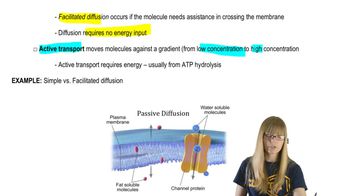
Movement of molecules down a gradient without energy input, occurring via simple or facilitated diffusion.
Simple Diffusion
Unassisted movement of molecules directly through the membrane, requiring no proteins or energy.
Facilitated Diffusion
Transport of molecules across the membrane with the help of proteins, but without energy expenditure.
Active Transport
Energy-dependent movement of molecules against their gradient, typically powered by ATP.
Channel Protein
Membrane protein forming a selective portal, allowing passage based on size or charge.
Transporter
Highly selective membrane protein permitting only specific molecules to bind and cross.
ATP-Powered Pump
Membrane protein using ATP energy to move substances across the membrane against their gradient.
Extracellular Environment
Area outside the cell, differing in composition from the cell's interior and influencing transport processes.
Intracellular Environment
Internal cellular space with distinct concentrations and charges compared to the outside, crucial for maintaining gradients.
 IndietroIndietro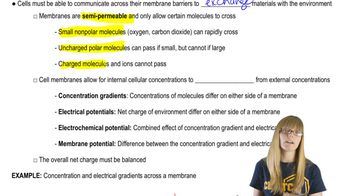
 03:37
03:37