Skip to main content
Cell Biology
Il mio corso
Impara
Preparazione agli esami
AI Tutor
Guide di studio
Flashcard
Esplora
Prova l'app
Il mio corso
Impara
Preparazione agli esami
AI Tutor
Guide di studio
Flashcard
Esplora
Prova l'app
Indietro
Prokaryotes vs. Eukaryotes definitions
Puoi toccare per girare la carta.
Prokaryote
Puoi toccare per girare la carta.
👆
Prokaryote
A cell type lacking a nucleus and internal membranes, with circular DNA located in a nucleoid region.
Avanzamenti del tracciato
I pulsanti di controllo sono stati cambiati in modalità "navigazione".
1/14
Flashcard correlate
Pratica correlata
Video consigliati
Prokaryotes vs. Eukaryotes quiz #1
Prokaryotes vs. Eukaryotes
40 Termini
Prokaryotes vs. Eukaryotes quiz #2
Prokaryotes vs. Eukaryotes
17 Termini
Prokaryotes vs. Eukaryotes
1. Overview of Cell Biology
7 Problemi
Argomento
Model Organisms
1. Overview of Cell Biology
7 Problemi
Argomento
1. Overview of Cell Biology - Part 1 of 2
5 Argomenti
14 Problemi
Capitolo
1. Overview of Cell Biology - Part 2 of 2
5 Argomenti
13 Problemi
Capitolo
VideoThumbView.guidedCourse
03:04
Comparing Prokaryotes and Eukaryotes
971
views
5
rank
Termini in questo insieme (14)
Nascondere definizioni
Prokaryote
A cell type lacking a nucleus and internal membranes, with circular DNA located in a nucleoid region.
Eukaryote
A cell type possessing a nucleus with a nuclear envelope, linear chromosomes, and complex internal membranes.
Nucleoid
A region in certain cells where circular DNA is free-floating, not enclosed by a membrane.
Nucleus
A membrane-bound compartment in some cells that houses linear DNA and is surrounded by a nuclear envelope.
Chromosome
A structure composed of DNA, linear in some cells and circular in others, responsible for genetic information storage.
Plasma Membrane
A boundary present in all cells, regulating the movement of substances into and out of the cell.
Internal Membrane
A feature of certain cells, forming compartments and organelles, absent in simpler cell types.
Cytoskeletal System
A network of microtubules, actin filaments, and intermediate filaments providing structural support in complex cells.
Binary Fission
A division process where a cell duplicates its DNA and splits, producing genetically identical offspring.
Mitosis
A division mechanism in complex cells resulting in two genetically identical daughter cells.
Meiosis
A division process in certain cells producing offspring with half the parental DNA, requiring two parents for full genetic complement.
Archaea
A domain of simple cells lacking a nucleus, often found in extreme environments, distinct from bacteria.
Bacteria
A domain of prokaryotic cells characterized by the absence of a nucleus and internal membranes.
Eukaryota
A domain including all organisms with cells containing a nucleus and internal compartmentalization.
 IndietroIndietro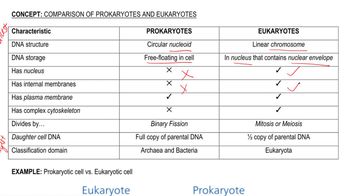
 03:04
03:04