Skip to main content
Cell Biology
Il mio corso
Impara
Preparazione agli esami
AI Tutor
Guide di studio
Flashcard
Esplora
Prova l'app
Il mio corso
Impara
Preparazione agli esami
AI Tutor
Guide di studio
Flashcard
Esplora
Prova l'app
Indietro
Properties of the Cell definitions
Puoi toccare per girare la carta.
Ancestral Cell
Puoi toccare per girare la carta.
👆
Ancestral Cell
Earliest single-celled organism from which all life diversified into three domains through evolutionary processes.
Avanzamenti del tracciato
I pulsanti di controllo sono stati cambiati in modalità "navigazione".
1/15
Flashcard correlate
Pratica correlata
Video consigliati
Properties of the Cell quiz #1
Properties of the Cell
40 Termini
Properties of the Cell quiz #2
Properties of the Cell
14 Termini
Properties of the Cell
1. Overview of Cell Biology
7 Problemi
Argomento
History of Cell Biology
1. Overview of Cell Biology
6 Problemi
Argomento
1. Overview of Cell Biology - Part 1 of 2
5 Argomenti
14 Problemi
Capitolo
1. Overview of Cell Biology - Part 2 of 2
5 Argomenti
13 Problemi
Capitolo
VideoThumbView.guidedCourse
02:26
Cells and Energy
794
views
20
rank
VideoThumbView.guidedCourse
02:23
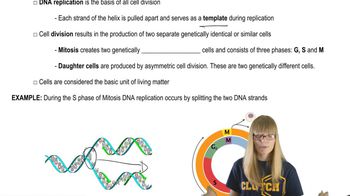
Cell Replication
1012
views
14
rank
VideoThumbView.guidedCourse
02:53
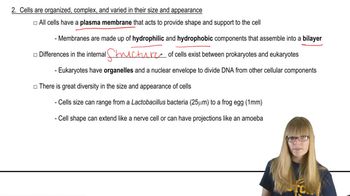
Cell Organization
1254
views
33
rank
Termini in questo insieme (15)
Nascondere definizioni
Ancestral Cell
Earliest single-celled organism from which all life diversified into three domains through evolutionary processes.
Plasma Membrane
Selective barrier composed of hydrophilic and hydrophobic components, forming a bilayer that encloses cellular contents.
Prokaryotes
Organisms lacking organelles and a nuclear envelope, including Bacteria and Archaea, with simpler internal structure.
Eukaryotes
Cells containing organelles and a nuclear envelope, allowing compartmentalization of cellular functions.
Genome
Complete set of genetic material in an organism, varying in size and gene number across species.
Central Dogma
Flow of genetic information from DNA to RNA to protein, underlying gene expression in all cells.
Mitosis
Cell division process producing genetically identical daughter cells, essential for growth and tissue maintenance.
Meiosis
Cell division process generating genetically diverse cells, crucial for sexual reproduction.
Organotrophs
Organisms obtaining energy by consuming organic molecules from other living things.
Phototrophs
Organisms capturing energy directly from sunlight to power cellular activities.
Lithotrophs
Organisms deriving energy from inorganic chemical sources, independent of organic matter or sunlight.
ATP
Primary energy storage molecule, releasing energy through phosphate bond hydrolysis to drive cellular reactions.
Enzymes
Proteins that accelerate chemical reactions, enabling efficient metabolism and cellular function.
Surface Area to Volume Ratio
Mathematical relationship influencing cell size, transport efficiency, and material exchange across membranes.
Feedback Circuitry
Self-regulating mechanism where reaction products modulate pathway activity, maintaining cellular stability.
 IndietroIndietro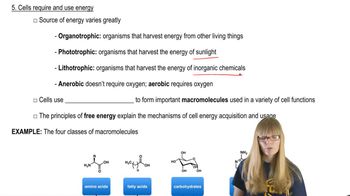
 02:26
02:26