Skip to main content
Cell Biology
Il mio corso
Impara
Preparazione agli esami
AI Tutor
Guide di studio
Flashcard
Esplora
Prova l'app
Il mio corso
Impara
Preparazione agli esami
AI Tutor
Guide di studio
Flashcard
Esplora
Prova l'app
Indietro
Small Molecules definitions
Puoi toccare per girare la carta.
Water
Puoi toccare per girare la carta.
👆
Water
Universal solvent making up about 70% of cell weight, with unique polarity and cohesion crucial for cellular processes.
Avanzamenti del tracciato
I pulsanti di controllo sono stati cambiati in modalità "navigazione".
1/13
Flashcard correlate
Pratica correlata
Video consigliati
Small Molecules quiz #1
Small Molecules
14 Termini
Small Molecules
2. Chemical Components of Cells
7 Problemi
Argomento
Chemical Bonds
2. Chemical Components of Cells
7 Problemi
Argomento
2. Chemical Components of Cells
5 Argomenti
14 Problemi
Capitolo
VideoThumbView.guidedCourse
05:53
Water and Carbon
1173
views
29
rank
Termini in questo insieme (13)
Nascondere definizioni
Water
Universal solvent making up about 70% of cell weight, with unique polarity and cohesion crucial for cellular processes.
Hydrophilic Molecule
Substance that dissolves readily in water due to its affinity for the polar nature of water molecules.
Hydrophobic Molecule
Substance that does not dissolve in water, repelled by water's polarity and often found in nonpolar regions.
Polarity
Uneven distribution of electrical charge within a molecule, leading to partial positive and negative regions.
Cohesion
Attraction between like molecules, especially water, resulting from polarity and enabling unique properties.
Specific Heat
Amount of heat required to raise the temperature of one gram of a substance by one degree Celsius; high in water.
Carbon
Element capable of forming four stable covalent bonds, serving as a backbone for diverse biological molecules.
Covalent Bond
Strong, stable chemical linkage formed by sharing electron pairs between atoms, common in organic molecules.
Bond Energy
Measurement of the energy needed to break a chemical bond, indicating the bond's stability and strength.
Stereoisomer
Molecule with the same chemical formula as another but differing in spatial arrangement, often as mirror images.
Asymmetric Carbon Atom
Central atom bonded to four different groups, resulting in non-superimposable mirror image configurations.
Functional Group
Specific cluster of atoms attached to carbon skeletons, imparting distinct chemical properties to molecules.
Chiral Center
Atom, typically carbon, with four different substituents, leading to molecules with handedness or chirality.
 IndietroIndietro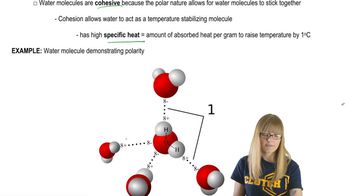
 05:53
05:53