 Indietro
Cell Biology: Macromolecules and Their Functions
 04:36
04:36
Termini in questo insieme (21)
Proteins, nucleic acids, carbohydrates, and lipids are the four major classes of macromolecules essential for cell structure, function, and regulation.
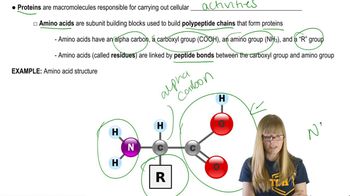
Proteins are polymers of 20 standard amino acids, each with a central alpha carbon bonded to an amino group, carboxyl group, hydrogen atom, and a unique side chain (R group).
Examples include enzymes (catalyze reactions), structural proteins (support and shape), and transport proteins (move substances across membranes).
Amino acids are linked by peptide bonds formed through condensation (dehydration) reactions, releasing water and creating polypeptides.
The linear sequence of amino acids in a polypeptide chain, written from the N-terminus to the C-terminus, determines all higher levels of structure.
Regular folding patterns stabilized by hydrogen bonds, mainly alpha helices (right-handed coils) and beta sheets (extended strands).
Interactions among R groups such as hydrophobic interactions, hydrogen bonds, ionic bonds, and disulfide bridges stabilize the overall 3D shape.
The association of multiple polypeptide subunits into a functional protein complex.
Changes in pH, temperature, or chemical environment can disrupt protein structure, causing loss of function.
Polymers of nucleotides, each containing a five-carbon sugar, phosphate group, and nitrogenous base.
DNA contains deoxyribose, while RNA contains ribose as the five-carbon sugar.
By 3',5'-phosphodiester bonds forming a sugar-phosphate backbone with directionality from 5' to 3'.
A pairs with T and G pairs with C via hydrogen bonds, forming the double helix structure.
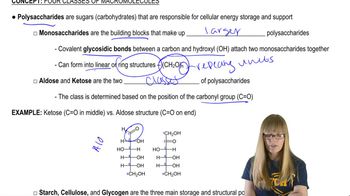
As monosaccharides (simple sugars), disaccharides (two monosaccharides), and polysaccharides (long chains).
A covalent bond formed by condensation between two monosaccharides to create disaccharides or polysaccharides.
Starch in plants and glycogen in animals serve as energy storage polysaccharides.
Cellulose is a structural polysaccharide forming plant cell walls.
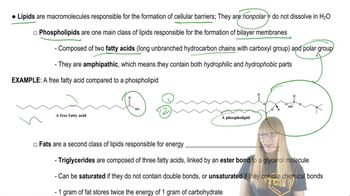
Hydrophobic molecules including fats, phospholipids, and steroids; they function in energy storage, membrane structure, and signaling.
One glycerol molecule bonded to three fatty acids, which can be saturated or unsaturated.
Consist of two fatty acids, a glycerol, and a phosphate group; they are amphipathic and form cellular membranes as bilayers.
Steroids have a four-ring structure; cholesterol is a common steroid and precursor for hormones.