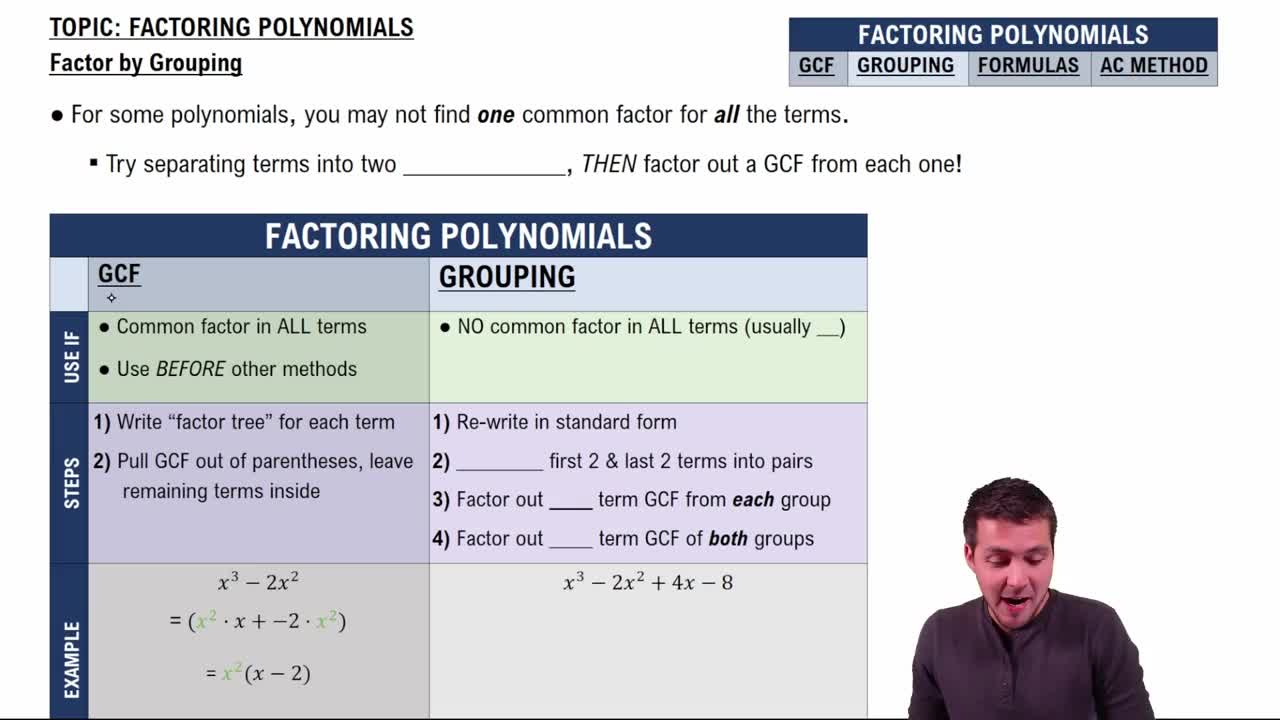
In Exercises 1–22, factor each difference of two squares. Assume that any variable exponents represent whole numbers.
x² - 4
Guida verificata passo dopo passo
1
Identify the expression as a difference of squares: \(x^2 - 4\).
Recall the formula for factoring a difference of squares: \(a^2 - b^2 = (a - b)(a + b)\).
Recognize that \(x^2\) is a perfect square with \(a = x\) and \(4\) is a perfect square with \(b = 2\).
Apply the difference of squares formula: substitute \(a = x\) and \(b = 2\) into \((a - b)(a + b)\).
Write the factored form: \((x - 2)(x + 2)\).
Risposta video verificata per un problema simile:
Questa soluzione video è stata consigliata dai nostri tutor come utile per risolvere questo problema.
Durata del video:
2m
Guarda un video:
0 Commenti
Concetti chiave
Ecco i concetti essenziali che devi comprendere per rispondere correttamente alla domanda.
Difference of Squares
The difference of squares is a specific algebraic expression that takes the form a² - b², where a and b are any algebraic expressions. This expression can be factored into (a - b)(a + b). Understanding this concept is crucial for recognizing and applying the factoring technique to simplify expressions like x² - 4.
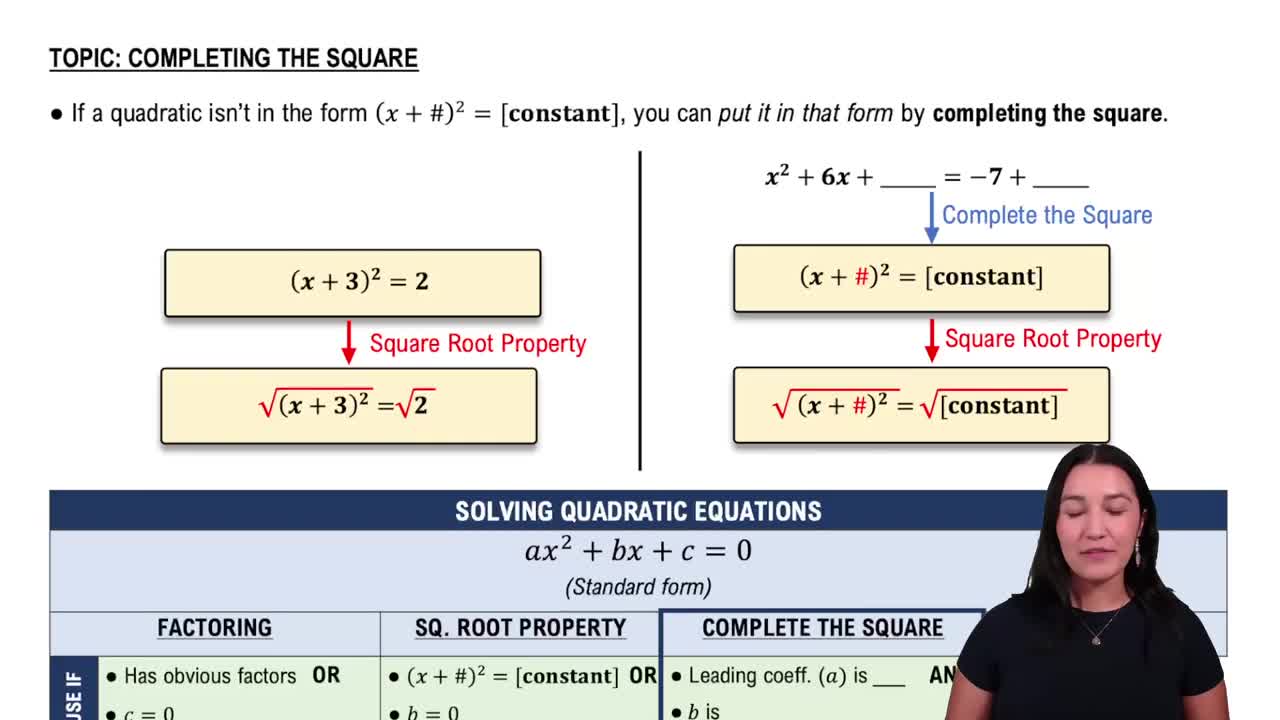
Solving Quadratic Equations by Completing the Square
Factoring
Factoring is the process of breaking down an expression into simpler components, or factors, that when multiplied together yield the original expression. In the case of the difference of squares, recognizing the structure allows for efficient simplification, which is a fundamental skill in algebra that aids in solving equations and simplifying expressions.
Exponents represent the number of times a base is multiplied by itself. In the expression x² - 4, the exponent indicates that x is squared. Understanding exponents is essential for manipulating algebraic expressions, as they dictate the behavior of the variables involved, especially when factoring or simplifying expressions.

 2:46 minuti
 Guida verificata passo dopo passo
 06:24
06:24