In Exercises 1–34, solve each rational equation. If an equation has no solution, so state.
1/x + 2 = 3/x
Guida verificata passo dopo passo
1
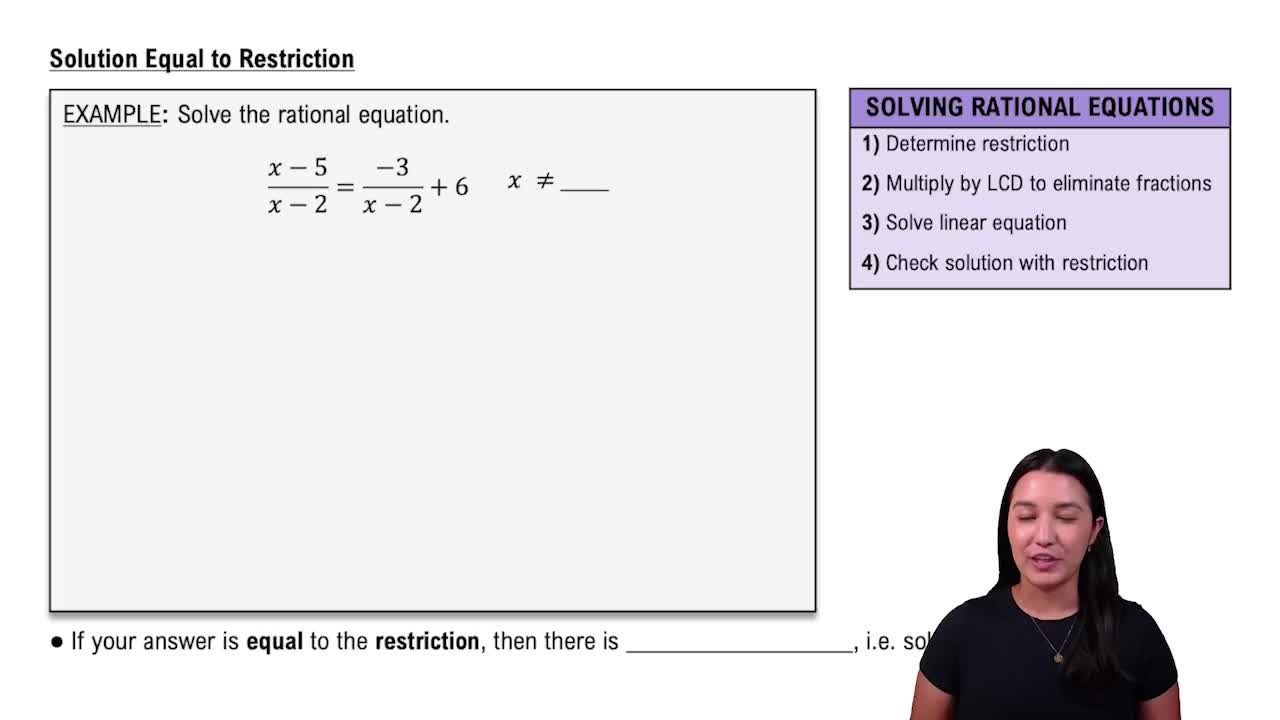
Identify the least common denominator (LCD) of the rational expressions. In this case, the LCD is \( x \).
Multiply every term in the equation by the LCD \( x \) to eliminate the fractions: \( x \cdot \frac{1}{x} + x \cdot 2 = x \cdot \frac{3}{x} \).
Simplify each term: \( 1 + 2x = 3 \).
Rearrange the equation to isolate the variable \( x \): \( 2x = 3 - 1 \).
Solve for \( x \) by dividing both sides by 2: \( x = \frac{2}{2} \).
Risposta video verificata per un problema simile:
Questa soluzione video è stata consigliata dai nostri tutor come utile per risolvere questo problema.
Durata del video:
3m
Guarda un video:
0 Commenti
Concetti chiave
Ecco i concetti essenziali che devi comprendere per rispondere correttamente alla domanda.
Rational Equations
Rational equations are equations that involve fractions with polynomials in the numerator and denominator. To solve these equations, one typically seeks a common denominator to eliminate the fractions, allowing for easier manipulation and simplification. Understanding how to work with rational expressions is crucial for solving these types of equations.
Finding a common denominator is a key step in solving rational equations. It involves identifying a denominator that all fractions in the equation can share, which allows for the elimination of the fractions. This process simplifies the equation, making it easier to isolate the variable and solve for its value.
When solving rational equations, it is important to check for extraneous solutions, which are values that may satisfy the manipulated equation but do not satisfy the original equation. This often occurs when the process of eliminating fractions introduces solutions that make the original denominators zero, leading to undefined expressions. Verifying solutions ensures that the final answer is valid.