Skip to main content
College Algebra
Il mio corso
Impara
Preparazione agli esami
AI Tutor
Guide di studio
Soluzioni per libri di testo
Flashcard
Esplora
Prova l'app
Il mio corso
Impara
Preparazione agli esami
AI Tutor
Guide di studio
Soluzioni per libri di testo
Flashcard
Esplora
Prova l'app
Indietro
Arithmetic Sequences quiz
Puoi toccare per girare la carta.
What is the defining characteristic of an arithmetic sequence?
Puoi toccare per girare la carta.
👆
What is the defining characteristic of an arithmetic sequence?
An arithmetic sequence has a constant difference, called the common difference (d), between consecutive terms.
Avanzamenti del tracciato
I pulsanti di controllo sono stati cambiati in modalità "navigazione".
1/15
Flashcard correlate
Pratica correlata
Video consigliati
Arithmetic Sequences definitions
Arithmetic Sequences
15 Termini
Arithmetic Sequences
9. Sequences, Series, & Induction
4 Problemi
Argomento
Callie
Geometric Sequences
9. Sequences, Series, & Induction
4 Problemi
Argomento
Callie
9. Sequences, Series, & Induction
3 Argomenti
6 Problemi
Capitolo
Callie
7:00
Example 2
812
views
5
rank
2:35
Example 1
748
views
1
rank
6:40
Arithmetic Sequences - Recursive Formula
1407
views
5
rank
Termini in questo insieme (15)
Nascondere definizioni
What is the defining characteristic of an arithmetic sequence?
An arithmetic sequence has a constant difference, called the common difference (d), between consecutive terms.
How do you find the common difference in an arithmetic sequence?
Subtract any term from the next term in the sequence; the result is the common difference d.
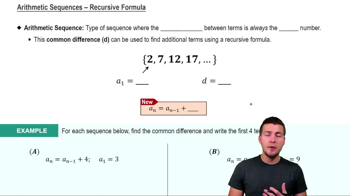
What is the recursive formula for an arithmetic sequence?
The recursive formula is an = an-1 + d, where d is the common difference and the first term is specified.
Why must you specify the first term when writing a recursive formula for an arithmetic sequence?
Without the first term, you wouldn't know where to start the sequence, so it's necessary to specify it.
What is the general formula for the nth term of an arithmetic sequence?
The general formula is an = a1 + d(n-1), where a1 is the first term and d is the common difference.
How does the general formula differ from the recursive formula for arithmetic sequences?
The general formula allows you to find any term directly using n, while the recursive formula requires knowing the previous term.
If the first term of an arithmetic sequence is 3 and the common difference is 4, what are the first four terms?
The first four terms are 3, 7, 11, and 15.
In the sequence 9, 3, -3, -9, what is the common difference?
The common difference is -6.
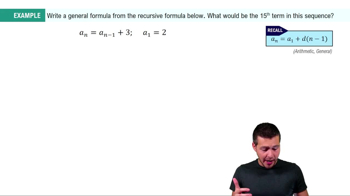
How do you write a recursive formula for the sequence 2, 5, 8, 11, 14?
The recursive formula is an = an-1 + 3, with a1 = 2.
What is the value of the 4th term in the sequence defined by a1 = 2 and d = 5?
The 4th term is 17.
How would you use the general formula to find the 101st term of the sequence 2, 5, 8, 11, 14?
Plug n = 101 into the formula: a101 = 2 + 3(101-1) = 302.
What does the variable n represent in the general formula for arithmetic sequences?
n represents the position of the term in the sequence.
Can the common difference in an arithmetic sequence be negative?
Yes, the common difference can be negative, causing the sequence to decrease.
Why is the general formula useful for finding terms with large indices?
It allows you to calculate any term directly without computing all previous terms.
What two pieces of information do you need to write the general formula for an arithmetic sequence?
You need the first term (a1) and the common difference (d).
 IndietroIndietro
 7:00
7:00