Skip to main content
College Algebra
Il mio corso
Impara
Preparazione agli esami
AI Tutor
Guide di studio
Soluzioni per libri di testo
Flashcard
Esplora
Prova l'app
Il mio corso
Impara
Preparazione agli esami
AI Tutor
Guide di studio
Soluzioni per libri di testo
Flashcard
Esplora
Prova l'app
Indietro
Function Composition quiz
Puoi toccare per girare la carta.
What does it mean to compose two functions, such as f(g(x))?
Puoi toccare per girare la carta.
👆
What does it mean to compose two functions, such as f(g(x))?
Composing two functions means replacing the variable in one function with another function, resulting in a new function.
Avanzamenti del tracciato
I pulsanti di controllo sono stati cambiati in modalità "navigazione".
1/15
Flashcard correlate
Pratica correlata
Video consigliati
Function Composition definitions
Function Composition
15 Termini
Function Composition
3. Functions
6 Problemi
Argomento
Callie
Function Operations
3. Functions
6 Problemi
Argomento
Justin
3. Functions
5 Argomenti
13 Problemi
Capitolo
Callie
4:26
Evaluating Composed Functions
2258
views
41
rank
1:46
Decomposition of Functions Example 1
1810
views
43
rank
3:51
Domain Restrictions of Composed Functions
1969
views
24
rank
Termini in questo insieme (15)
Nascondere definizioni
What does it mean to compose two functions, such as f(g(x))?
Composing two functions means replacing the variable in one function with another function, resulting in a new function.
If f(x) = x^2 + 3x - 10 and g(x) = x - 2, what is f(g(x))?
f(g(x)) = (x - 2)^2 + 3(x - 2) - 10, which simplifies to x^2 - x - 12.
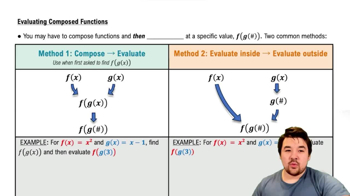
How do you evaluate a composed function at a specific value using the two-step method?
First, evaluate the inner function at the given value, then substitute this result into the outer function.
What is the shortcut method for evaluating f(g(a))?
Evaluate g(a) first, then plug that result into f(x) to get f(g(a)).
Why might you not always use the shortcut method for evaluating composed functions?
Because sometimes you are required to find the general form of f(g(x)) before substituting a value.
If f(x) = x + 4 and g(x) = x^2 - 3, what is f(g(x))?
f(g(x)) = (x^2 - 3) + 4 = x^2 + 1.
If f(x) = x + 4 and g(x) = x^2 - 3, what is g(f(x))?
g(f(x)) = (x + 4)^2 - 3, which expands to x^2 + 8x + 16 - 3 = x^2 + 8x + 13.
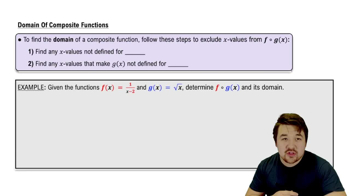
How do you find the domain of a composed function f(g(x))?
Find the domain restrictions for both g(x) and f(g(x)), then combine these restrictions for the overall domain.
If f(x) = 1/(x-2) and g(x) = sqrt(x), what is the domain of f(g(x))?
The domain is all x ≥ 0 except x ≠ 4, so [0, 4) ∪ (4, ∞).
Why must you consider the domain of both the inner and outer functions when composing functions?
Because the input must be valid for the inner function and the result must be valid for the outer function.
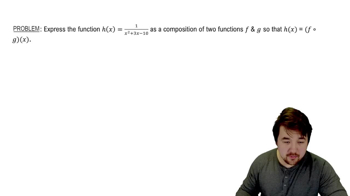
What is function decomposition?
Function decomposition is expressing a single function as the composition of two functions, f and g.
Given h(x) = sqrt(x - 2), how can you decompose h(x) into f(g(x))?
Let g(x) = x - 2 and f(x) = sqrt(x), so h(x) = f(g(x)).
Is there only one correct way to decompose a function?
No, there are multiple correct ways to decompose a function, depending on how you define f(x) and g(x).
What is a common strategy for decomposing a function involving a square root?
Set g(x) equal to the expression inside the square root and f(x) equal to the square root function.
How can creativity play a role in function decomposition?
You can choose different expressions for g(x) and adjust f(x) accordingly, as long as their composition gives the original function.
 IndietroIndietro

 4:26
4:26