Skip to main content
College Algebra
Il mio corso
Impara
Preparazione agli esami
AI Tutor
Guide di studio
Soluzioni per libri di testo
Flashcard
Esplora
Prova l'app
Il mio corso
Impara
Preparazione agli esami
AI Tutor
Guide di studio
Soluzioni per libri di testo
Flashcard
Esplora
Prova l'app
Indietro
Introduction to Conic Sections quiz
Puoi toccare per girare la carta.
What are conic sections?
Puoi toccare per girare la carta.
👆
What are conic sections?
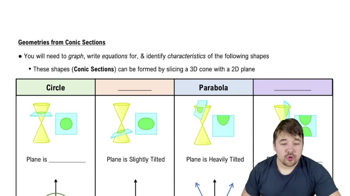
Conic sections are shapes formed by slicing a three-dimensional cone with a two-dimensional plane.
Avanzamenti del tracciato
I pulsanti di controllo sono stati cambiati in modalità "navigazione".
1/15
Flashcard correlate
Pratica correlata
Video consigliati
Introduction to Conic Sections definitions
Introduction to Conic Sections
14 Termini
Introduction to Conic Sections
8. Conic Sections
4 Problemi
Argomento
Justin
Circles
8. Conic Sections
2 Problemi
Argomento
Justin
8. Conic Sections
6 Argomenti
8 Problemi
Capitolo
Callie
3:08
Geometries from Conic Sections
1070
views
7
rank
Termini in questo insieme (15)
Nascondere definizioni
What are conic sections?
Conic sections are shapes formed by slicing a three-dimensional cone with a two-dimensional plane.
How is a circle formed as a conic section?
A circle is formed by making a horizontal slice through a cone.
What shape results from slicing a cone at a slight angle?
Slicing a cone at a slight angle produces an ellipse.
How does the ellipse differ from the circle in conic sections?
An ellipse is like a stretched circle, created by a slightly tilted slice rather than a horizontal one.
What kind of slice produces a parabola from a cone?
A parabola is produced by slicing the cone with a heavily tilted plane.
Describe the shape of a parabola in conic sections.
A parabola is a curved, open shape resulting from a heavily tilted slice through the cone.
How is a hyperbola formed from a cone?
A hyperbola is formed by slicing the cone vertically, resulting in two diverging curves.
What is unique about the shape of a hyperbola?
A hyperbola consists of two curves that diverge away from each other.
Why is the slicing of a cone used as an analogy in conic sections?
The slicing analogy helps visualize and remember the different conic section shapes.
What are the four primary conic sections?
The four primary conic sections are the circle, ellipse, parabola, and hyperbola.
Does each conic section have an associated equation?
Yes, each conic section has its own associated equation.
What happens to the plane when forming a parabola compared to an ellipse?
For a parabola, the plane is heavily tilted, while for an ellipse, it is only slightly tilted.
Which conic section is described as the most unique in the lesson?
The hyperbola is described as the most unique conic section.
What is the purpose of learning about the equations of conic sections?
Learning the equations helps identify and analyze the properties of each conic section.
How can you remember the different types of conic sections?
You can remember them by visualizing how slicing a cone at different angles produces each shape.
 IndietroIndietro

 3:08
3:08