Skip to main content
College Algebra
Il mio corso
Impara
Preparazione agli esami
AI Tutor
Guide di studio
Soluzioni per libri di testo
Flashcard
Esplora
Prova l'app
Il mio corso
Impara
Preparazione agli esami
AI Tutor
Guide di studio
Soluzioni per libri di testo
Flashcard
Esplora
Prova l'app
Indietro
Probability quiz
Puoi toccare per girare la carta.
What is the difference between theoretical and empirical probability?
Puoi toccare per girare la carta.
👆
What is the difference between theoretical and empirical probability?
Theoretical probability is based on possible outcomes before any events occur, while empirical probability is based on actual data from experiments.
Avanzamenti del tracciato
I pulsanti di controllo sono stati cambiati in modalità "navigazione".
1/15
Flashcard correlate
Pratica correlata
Video consigliati
Probability definitions
Probability
15 Termini
Probability
10. Combinatorics & Probability
3 Problemi
Argomento
Callie
Combinatorics
10. Combinatorics & Probability
4 Problemi
Argomento
Callie
10. Combinatorics & Probability
3 Argomenti
5 Problemi
Capitolo
Justin
2:57
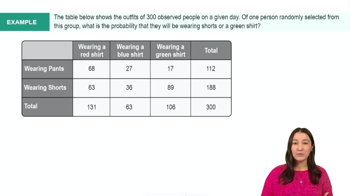
Probability of Non-Mutually Exclusive Events Example
1006
views
2
rank
5:54
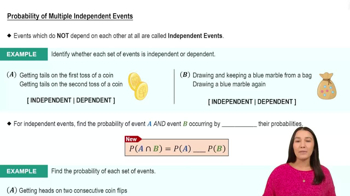
Probability of Multiple Independent Events
675
views
5:14
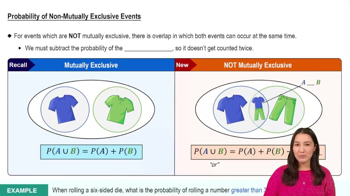
Probability of Non-Mutually Exclusive Events
806
views
2
rank
Termini in questo insieme (15)
Nascondere definizioni
What is the difference between theoretical and empirical probability?
Theoretical probability is based on possible outcomes before any events occur, while empirical probability is based on actual data from experiments.
How do you calculate the theoretical probability of an event?
Divide the number of favorable outcomes by the total number of possible outcomes.
How do you calculate the empirical probability of an event?
Divide the number of times the event actually occurred by the total number of trials.
What is a sample space in probability?
A sample space is the set of all possible outcomes of an experiment, usually written in curly brackets.
What is the complement of an event and how is its probability calculated?
The complement of an event is all outcomes where the event does not occur, and its probability is 1 minus the probability of the event.
If the probability of drawing a queen from a deck is 4/52, what is the probability of not drawing a queen?
It is 1 - 4/52 = 48/52, or approximately 0.92.
What does it mean for two events to be mutually exclusive?
Mutually exclusive events cannot happen at the same time; if one occurs, the other cannot.
How do you calculate the probability of either of two mutually exclusive events occurring?
Add the probabilities of each event: P(A or B) = P(A) + P(B).
What is the formula for the probability of either of two non-mutually exclusive events occurring?
P(A or B) = P(A) + P(B) - P(A and B).
Why do you subtract P(A and B) when calculating the probability of 'A or B' for non-mutually exclusive events?
Because the overlap (where both events occur) is counted twice, so you subtract it once to correct the total.
What does it mean for two events to be independent?
Two events are independent if the outcome of one does not affect the outcome of the other.
How do you calculate the probability of two independent events both occurring?
Multiply their individual probabilities: P(A and B) = P(A) × P(B).
If you flip a coin twice, what is the probability of getting heads both times?
It is 1/2 × 1/2 = 1/4 or 0.25.
What is the general formula for the probability of 'A or B' for any two events?
P(A or B) = P(A) + P(B) - P(A and B), which works for both mutually exclusive and non-mutually exclusive events.
How do you find the probability of multiple independent events all occurring?
Multiply the probabilities of each event together.
 IndietroIndietro

 2:57
2:57