Skip to main content
College Algebra
Il mio corso
Impara
Preparazione agli esami
AI Tutor
Guide di studio
Soluzioni per libri di testo
Flashcard
Esplora
Prova l'app
Il mio corso
Impara
Preparazione agli esami
AI Tutor
Guide di studio
Soluzioni per libri di testo
Flashcard
Esplora
Prova l'app
Indietro
Rational Exponents quiz
Puoi toccare per girare la carta.
How can the square root of a number be expressed using exponents?
Puoi toccare per girare la carta.
👆
How can the square root of a number be expressed using exponents?
The square root of a number can be written as the number raised to the power of one-half.
Avanzamenti del tracciato
I pulsanti di controllo sono stati cambiati in modalità "navigazione".
1/15
Flashcard correlate
Pratica correlata
Video consigliati
Rational Exponents definitions
Rational Exponents
15 Termini
Rational Exponents
0. Review of Algebra
4 Problemi
Argomento
Callie
0. Review of Algebra - Part 1 of 2
5 Argomenti
10 Problemi
Capitolo
Callie
0. Review of Algebra - Part 2 of 2
3 Argomenti
10 Problemi
Capitolo
Callie
04:06
Rational Exponents
3111
views
141
rank
1
comments
Termini in questo insieme (15)
Nascondere definizioni
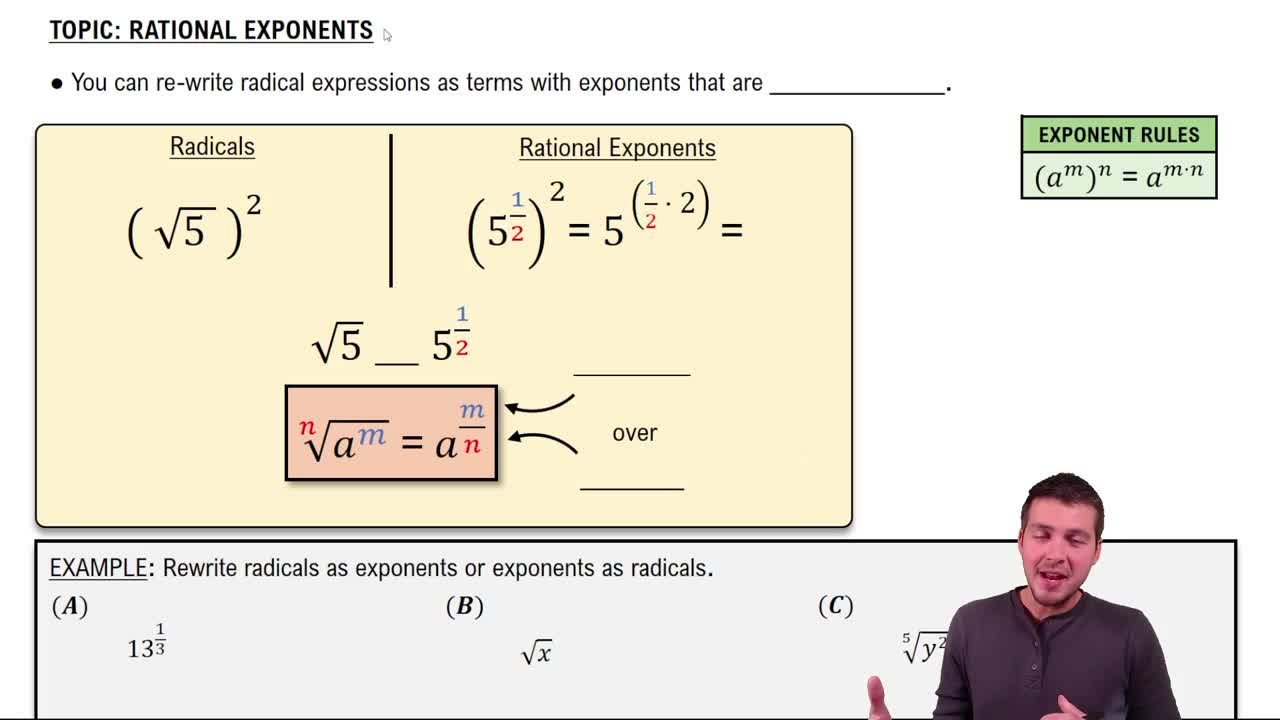
How can the square root of a number be expressed using exponents?
The square root of a number can be written as the number raised to the power of one-half.
What is a rational exponent?
A rational exponent is an exponent that is a fraction, representing both a power and a root.
How do you convert the cube root of 13 to an exponent?
The cube root of 13 is written as 13 to the one-third power, or 13^(1/3).
What does the denominator of a fractional exponent represent?
The denominator represents the index or root of the radical.
What does the numerator of a fractional exponent represent?
The numerator represents the power of the term inside the radical.
How would you write the square root of x as an exponent?
The square root of x is written as x^(1/2).
How do you convert y squared under a fifth root to a rational exponent?
It becomes y^(2/5), with 2 as the numerator and 5 as the denominator.
What is the relationship between squaring a number and taking its square root?
Squaring and taking the square root are inverse operations.
How do you convert 5^(1/2) to a radical expression?
5^(1/2) is equivalent to the square root of 5.
What happens when you square 5^(1/2)?
You get 5, because (5^(1/2))^2 = 5^(1/2*2) = 5^1.
How do you convert a radical with an invisible index to a rational exponent?
The invisible index is 2 for square roots, so the exponent is 1/2.
How do you convert 13^(1/3) to a radical?
13^(1/3) is the cube root of 13.
How do you convert a radical expression with a variable to a rational exponent?
The variable under the root becomes the base, and the exponent is 1 divided by the index.
What is the general rule for converting radicals to rational exponents?
The power inside the radical becomes the numerator, and the index becomes the denominator.
Why are rational exponents also called fractional exponents?
Because they are written as fractions, representing both a power and a root.
 IndietroIndietro
 04:06
04:06