Skip to main content
College Algebra
Il mio corso
Impara
Preparazione agli esami
AI Tutor
Guide di studio
Soluzioni per libri di testo
Flashcard
Esplora
Prova l'app
Il mio corso
Impara
Preparazione agli esami
AI Tutor
Guide di studio
Soluzioni per libri di testo
Flashcard
Esplora
Prova l'app
Indietro
Rationalize Denominator quiz
Puoi toccare per girare la carta.
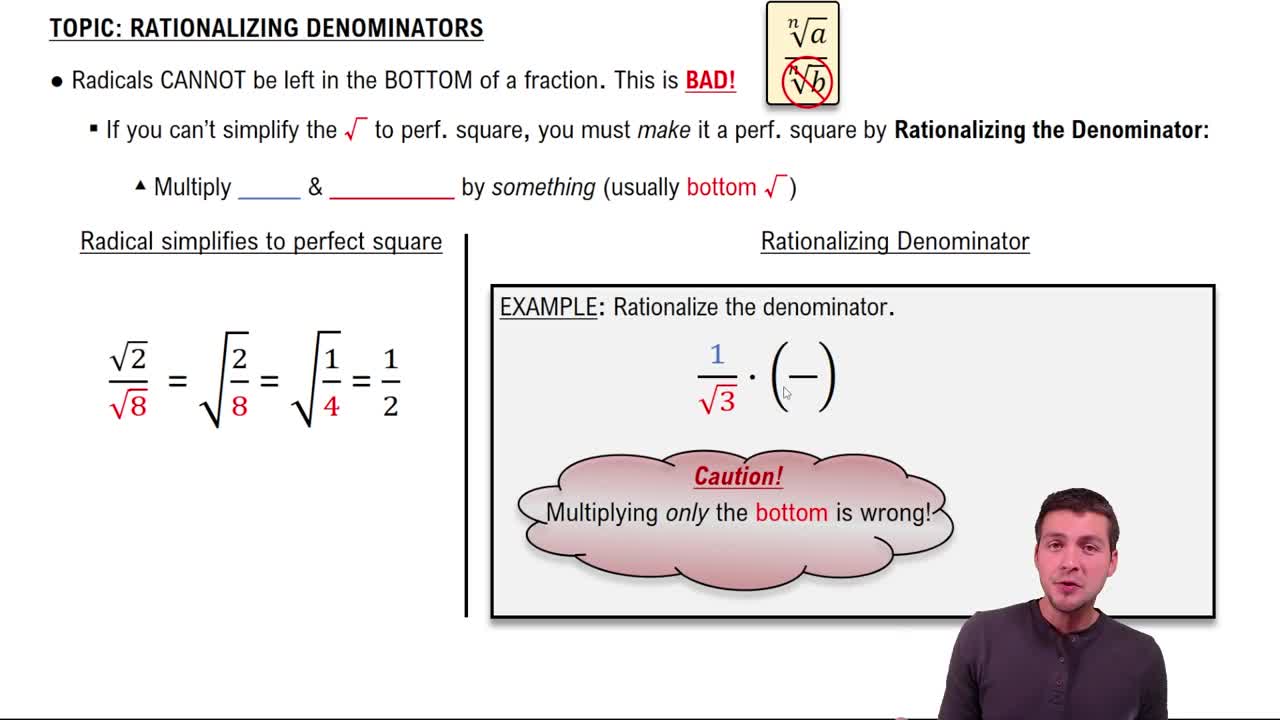
What does it mean to rationalize the denominator?
Puoi toccare per girare la carta.
👆
What does it mean to rationalize the denominator?
Rationalizing the denominator means eliminating any radicals from the bottom of a fraction.
Avanzamenti del tracciato
I pulsanti di controllo sono stati cambiati in modalità "navigazione".
1/15
Flashcard correlate
Pratica correlata
Video consigliati
Rationalize Denominator definitions
Rationalize Denominator
15 Termini
Rational Exponents
0. Review of Algebra
4 Problemi
Argomento
Callie
0. Review of Algebra - Part 1 of 2
5 Argomenti
10 Problemi
Capitolo
Callie
0. Review of Algebra - Part 2 of 2
3 Argomenti
10 Problemi
Capitolo
Callie
03:42
Rationalizing Denominators Using Conjugates
1579
views
13
rank
02:58
Rationalizing Denominators
2087
views
27
rank
Termini in questo insieme (15)
Nascondere definizioni
What does it mean to rationalize the denominator?
Rationalizing the denominator means eliminating any radicals from the bottom of a fraction.
Why can't you leave a radical in the denominator of a fraction?
It's a mathematical convention that radicals should not be left in the denominator; they must be removed to simplify the expression.
What do you multiply by to rationalize a denominator with a single radical term?
You multiply both the numerator and denominator by the radical itself.
What is the result of multiplying radical 3 by radical 3?
Multiplying radical 3 by radical 3 gives 3, which is a rational number.
If you have 1 over radical 3, what do you multiply by to rationalize the denominator?
You multiply both the numerator and denominator by radical 3.
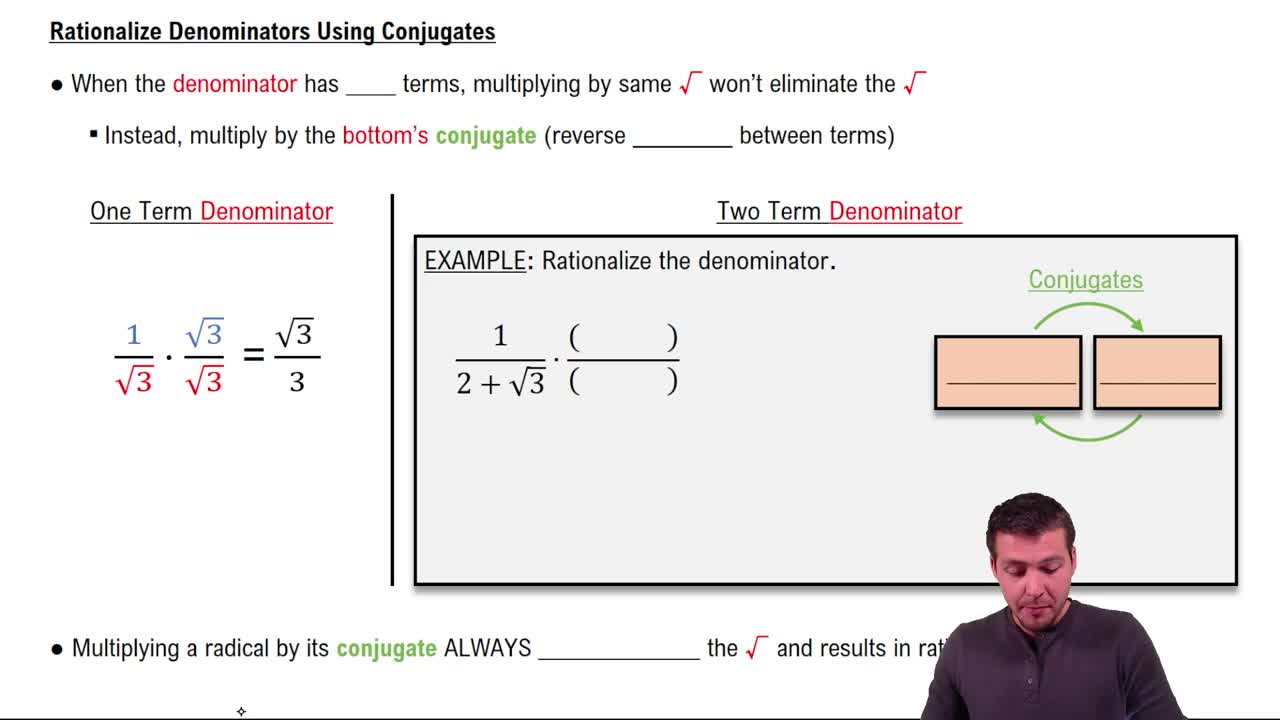
What is the conjugate of 2 + radical 3?
The conjugate of 2 + radical 3 is 2 - radical 3.
Why do you use the conjugate to rationalize denominators with two terms?
Using the conjugate eliminates the radical by creating a difference of squares in the denominator.
What is the general formula for the conjugate of a + radical b?
The conjugate is a - radical b.
What happens when you multiply a binomial by its conjugate?
Multiplying a binomial by its conjugate results in a difference of squares, removing the radical.
What do you always have to do to both the numerator and denominator when rationalizing?
You must multiply both the numerator and denominator by the same value to keep the fraction equivalent.
What is the simplified form of 1 over radical 3 after rationalizing the denominator?
The simplified form is radical 3 over 3.
What is the simplified denominator when you multiply (2 + radical 3) by its conjugate (2 - radical 3)?
The denominator becomes 4 - 3, which simplifies to 1.
What is the result of rationalizing 1 over (2 + radical 3)?
The result is (2 - radical 3) over 1, or just 2 - radical 3.
When is it acceptable to have a radical in a fraction?
It is acceptable to have a radical in the numerator, but not in the denominator.
What are the two main methods for rationalizing denominators?
Multiply by the radical for single-term denominators, and by the conjugate for two-term denominators.
 IndietroIndietro
 03:42
03:42