Skip to main content
College Algebra
Il mio corso
Impara
Preparazione agli esami
AI Tutor
Guide di studio
Soluzioni per libri di testo
Flashcard
Esplora
Prova l'app
Il mio corso
Impara
Preparazione agli esami
AI Tutor
Guide di studio
Soluzioni per libri di testo
Flashcard
Esplora
Prova l'app
Indietro
Two-Variable Equations quiz
1 Lo studente ha trovato utile questo
Puoi toccare per girare la carta.
What is the main difference between equations with one variable and equations with two variables?
Puoi toccare per girare la carta.
👆
What is the main difference between equations with one variable and equations with two variables?
Equations with one variable have a single solution, while equations with two variables have infinitely many solutions represented as ordered pairs.
Avanzamenti del tracciato
I pulsanti di controllo sono stati cambiati in modalità "navigazione".
1/15
Flashcard correlate
Pratica correlata
Video consigliati
Two-Variable Equations definitions
Two-Variable Equations
15 Termini
Two-Variable Equations
2. Graphs of Equations
5 Problemi
Argomento
Callie
Lines
2. Graphs of Equations
7 Problemi
Argomento
Callie
2. Graphs of Equations
3 Argomenti
8 Problemi
Capitolo
Callie
04:29
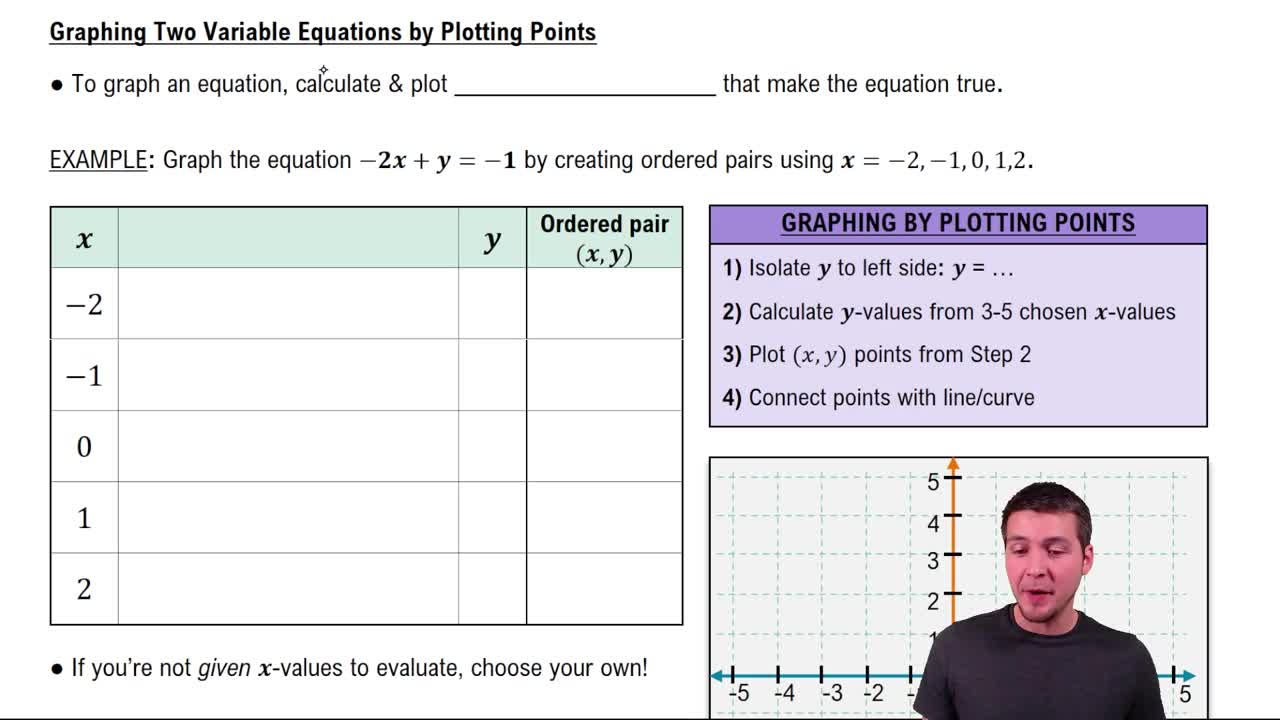
Graphing Equations of Two Variables by Plotting Points
2804
views
73
rank
1
comments
04:08
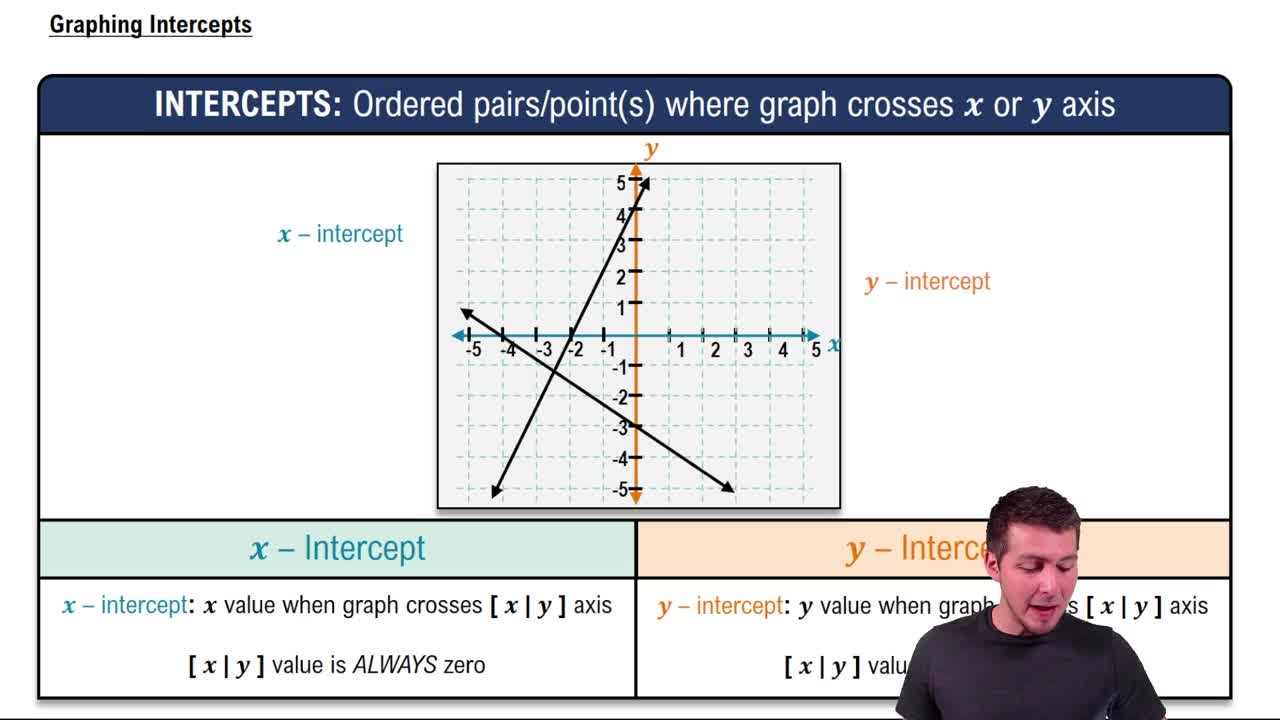
Graphing Intercepts
2346
views
80
rank
05:28
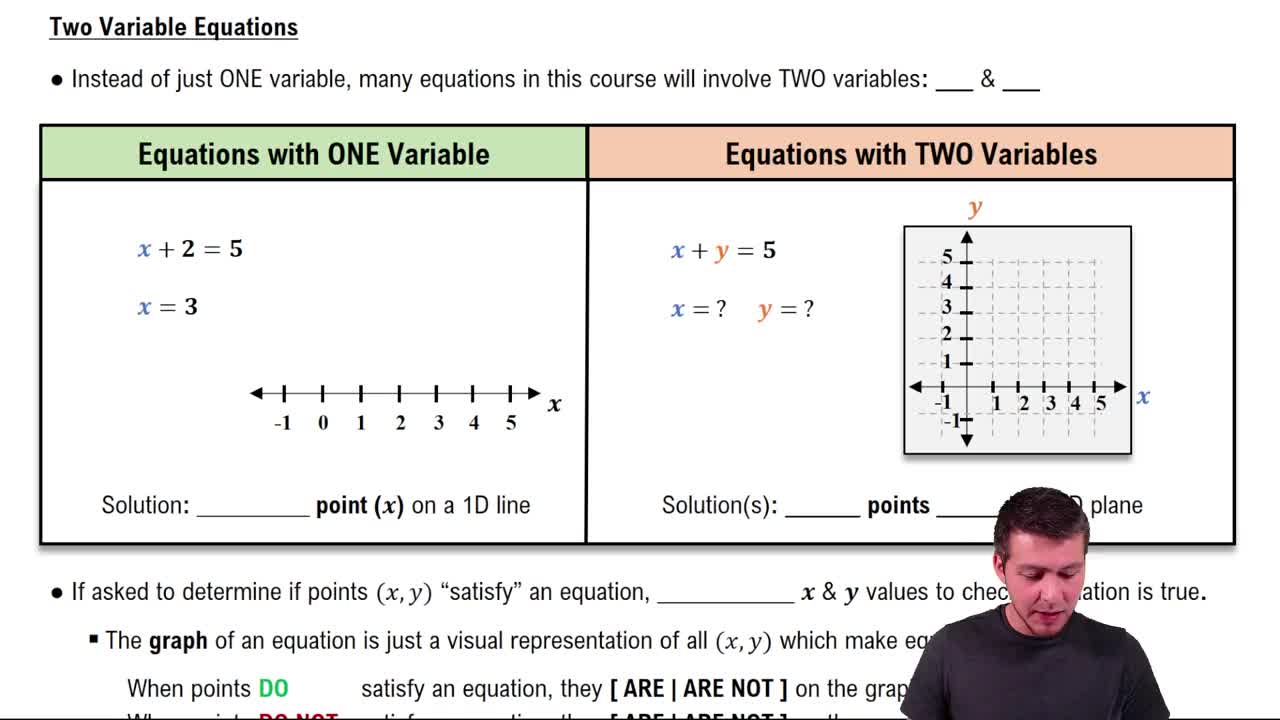
Equations with Two Variables
3805
views
94
rank
2
comments
Termini in questo insieme (15)
Nascondere definizioni
What is the main difference between equations with one variable and equations with two variables?
Equations with one variable have a single solution, while equations with two variables have infinitely many solutions represented as ordered pairs.
How do you determine if an ordered pair is a solution to a two-variable equation?
Substitute the x and y values from the ordered pair into the equation and check if the equation is true.
What does it mean for a point to satisfy a two-variable equation?
It means that when the point's x and y values are substituted into the equation, the equation holds true.
How are solutions to two-variable equations represented graphically?
They are represented as points (ordered pairs) on a two-dimensional plane.
What is the general process for graphing a two-variable equation like -2x + y = -1?
Isolate y, substitute various x values to find corresponding y values, plot the ordered pairs, and connect them with a line.
Why is it helpful to isolate y when graphing a two-variable equation?
Isolating y makes it easier to substitute x values and directly calculate the corresponding y values.
What is an x-intercept and how do you find it?
An x-intercept is where the graph crosses the x-axis, found by setting y = 0 and solving for x.
What is a y-intercept and how do you find it?
A y-intercept is where the graph crosses the y-axis, found by setting x = 0 and solving for y.
What is always true about the y value at an x-intercept?
The y value is always 0 at an x-intercept.
What is always true about the x value at a y-intercept?
The x value is always 0 at a y-intercept.
If you are asked for the x-intercepts of a graph, what should you provide?
You should provide the x values where the graph crosses the x-axis.
If you are asked for the intercepts of a graph (without specifying x or y), what should you provide?
You should provide the ordered pairs where the graph crosses the axes.
How many ordered pairs do you typically need to plot to graph a straight line from a two-variable equation?
Usually, 3 to 5 ordered pairs are enough to graph a straight line.
What happens to the graph of a two-variable equation if you plot all points that satisfy the equation?
You get a straight line (for linear equations) that passes through all those points.
What does it mean if a point does not lie on the graph of a two-variable equation?
It means the point does not satisfy the equation when its x and y values are substituted in.
 IndietroIndietro
 04:29
04:29