 Indietro
College Algebra: Functions
 3:43
3:43
Termini in questo insieme (20)
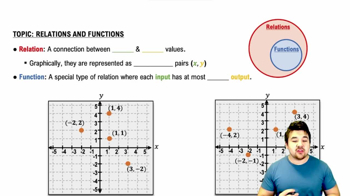
A function is a relation where each input has exactly one output.
A function is often represented as \(f(x)\), where x is the input and f(x) is the output.
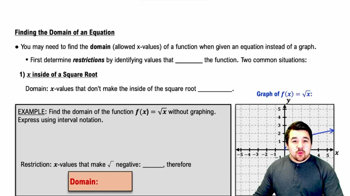
The domain is the set of all possible input values for the function.
The range is the set of all possible output values of the function.
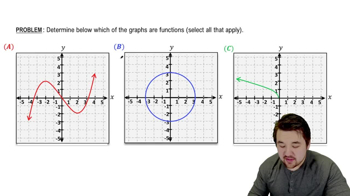
If any vertical line crosses the graph more than once, the relation is not a function.
A function is one-to-one if each output corresponds to exactly one input.
A function assigns exactly one output to each input, while a relation can assign multiple outputs to an input.
Function notation expresses functions as \(f(x)\), indicating the output for input x.
Substitute the input value into the function expression and simplify to find the output.
The composition of functions \(f(g(x))\) means applying g first, then f to the result.
The inverse function reverses the input-output pairs of the original function.
Swap x and y in the equation and solve for y.
A piecewise function is defined by different expressions over different parts of its domain.
Discrete functions have isolated points; continuous functions have unbroken graphs.
Adding a constant outside the function shifts the graph up or down.
Adding or subtracting inside the function argument shifts the graph left or right.
Multiplying by a constant stretches or compresses the graph vertically.
The standard form is \(f(x) = mx + b\), where m is slope and b is y-intercept.
The domain of a polynomial function is all real numbers.
A function is even if \(f(-x) = f(x)\) and odd if \(f(-x) = -f(x)\).