Skip to main content
College Algebra
Il mio corso
Impara
Preparazione agli esami
AI Tutor
Guide di studio
Soluzioni per libri di testo
Flashcard
Esplora
Prova l'app
Il mio corso
Impara
Preparazione agli esami
AI Tutor
Guide di studio
Soluzioni per libri di testo
Flashcard
Esplora
Prova l'app
Indietro
College Algebra: Functions and Graphs
Puoi toccare per girare la carta.
What does it mean for a function to be increasing on an interval?
Puoi toccare per girare la carta.
👆
What does it mean for a function to be increasing on an interval?
A function is
increasing
on an interval if the function values go up from left to right over that interval.
Avanzamenti del tracciato
I pulsanti di controllo sono stati cambiati in modalità "navigazione".
1/22
Video consigliati
3:43
Finding the Domain of an Equation
5297
views
102
rank
3
comments
1:30
Relations & Functions Example 1
6369
views
306
rank
5:20
Relations and Functions
12239
views
516
rank
2
comments
Termini in questo insieme (22)
Nascondere definizioni
What does it mean for a function to be increasing on an interval?
A function is
increasing
on an interval if the function values go up from left to right over that interval.
What does it mean for a function to be decreasing on an interval?
A function is
decreasing
on an interval if the function values go down from left to right over that interval.
What does it mean for a function to be constant on an interval?
A function is
constant
on an interval if the function values do not change (neither increase nor decrease) from left to right over that interval.
Define a relative (local) maximum of a function.
A function has a
relative maximum
at a point if the y-value there is larger than all other y-values near that point.
Define a relative (local) minimum of a function.
A function has a
relative minimum
at a point if the y-value there is smaller than all other y-values near that point.
What is x-axis symmetry in a relation?
A relation has
x-axis symmetry
if for every point (x,y), the point (x,-y) is also on the graph.
What is y-axis symmetry in a relation?
A relation has
y-axis symmetry
if for every point (x,y), the point (-x,y) is also on the graph.
What is origin symmetry in a relation?
A relation has
origin symmetry
if for every point (x,y), the point (-x,-y) is also on the graph.
Algebraic test for x-axis symmetry?
Replace y with -y in the equation. If the equation remains unchanged, the relation has x-axis symmetry.
Algebraic test for y-axis symmetry?
Replace x with -x in the equation. If the equation remains unchanged, the relation has y-axis symmetry.
Algebraic test for origin symmetry?
Replace x with -x and y with -y in the equation. If the equation remains unchanged, the relation has origin symmetry.
Algebraic definition of an even function?
A function f is
even
if \(f(-x) = f(x)\) for all x in its domain.
Algebraic definition of an odd function?
A function f is
odd
if \(f(-x) = -f(x)\) for all x in its domain.
Can a function have x-axis symmetry?
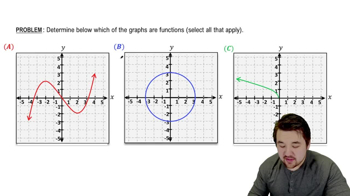
Virtually no functions have x-axis symmetry because that would fail the vertical line test.
What happens when you add or subtract even functions?
The result is always an even function.
What happens when you add or subtract odd functions?
The result is always an odd function.
What is a piecewise function?
A function defined by two or more different expressions over different parts of its domain.
What is the difference quotient of a function f?
The difference quotient is \(\frac{f(x+h) - f(x)}{h}\), where \(h \neq 0\).
Why is the difference quotient important?
It measures the average rate of change of the function over the interval from x to x+h and is foundational for derivatives.
How to determine intervals where a function is increasing or decreasing from a graph?
Look for intervals where the graph moves upward (increasing) or downward (decreasing) as you move left to right.
How to identify relative maxima and minima from a graph?
Relative maxima are peaks where the graph changes from increasing to decreasing; minima are valleys where it changes from decreasing to increasing.
How to determine if a function is even, odd, or neither from its graph?
Check for y-axis symmetry (even), origin symmetry (odd), or lack of both (neither).
 IndietroIndietro
 3:43
3:43