Skip to main content
College Algebra
Il mio corso
Impara
Preparazione agli esami
AI Tutor
Guide di studio
Soluzioni per libri di testo
Flashcard
Esplora
Prova l'app
Il mio corso
Impara
Preparazione agli esami
AI Tutor
Guide di studio
Soluzioni per libri di testo
Flashcard
Esplora
Prova l'app
Indietro
College Algebra: Graphs, Functions, and Lines
Puoi toccare per girare la carta.
What is the Rectangular Coordinate System?
Puoi toccare per girare la carta.
👆
What is the Rectangular Coordinate System?
A 2-D plane formed by two perpendicular number lines called the x-axis (horizontal) and y-axis (vertical).
Avanzamenti del tracciato
I pulsanti di controllo sono stati cambiati in modalità "navigazione".
1/29
Video consigliati
3:43
Finding the Domain of an Equation
5293
views
102
rank
3
comments
1:30
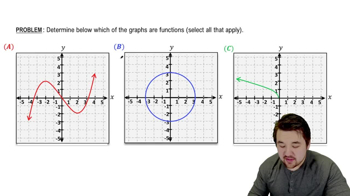
Relations & Functions Example 1
6363
views
306
rank
5:20
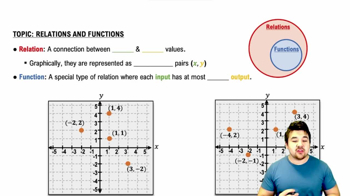
Relations and Functions
12232
views
516
rank
2
comments
Termini in questo insieme (29)
Nascondere definizioni
What is the Rectangular Coordinate System?
A 2-D plane formed by two perpendicular number lines called the x-axis (horizontal) and y-axis (vertical).
How are points represented on the Cartesian plane?
Points are represented as ordered pairs (x, y), where x is the horizontal position and y is the vertical position.
What is the origin in the coordinate system?
The origin is the point (0, 0) where the x-axis and y-axis intersect.
How are the quadrants numbered in the coordinate plane?
Quadrants are numbered counterclockwise starting from the top-right as Quadrant 1.
Define a relation in terms of x and y values.
A relation is a connection between input values (x) and output values (y), often represented as ordered pairs.
What defines a function among relations?
A function is a relation where each input (x) has at most one output (y).
What is the Vertical Line Test?
A graph represents a function if no vertical line intersects the graph at more than one point.
How do you verify if an equation is a function?
Solve for y; if y can be expressed as a function of x with only one output for each input, it is a function.
What is the domain of a function?
The domain is the set of all allowable x-values (inputs) for the function.
What is the range of a function?
The range is the set of all possible y-values (outputs) of the function.
How do you find the domain from a graph?
Project or 'squish' the graph onto the x-axis to find all x-values covered.
How do you find the range from a graph?
Project or 'squish' the graph onto the y-axis to find all y-values covered.
What are common domain restrictions when given an equation?
Exclude x-values that make the denominator zero or the radicand of a square root negative.
How do you find the slope of a line given two points?
Slope m = (y2 - y1) / (x2 - x1), the ratio of vertical change to horizontal change.
What are the types of slope and their signs?
Positive slope rises left to right, negative slope falls left to right, zero slope is horizontal, undefined slope is vertical.
What is the slope-intercept form of a line?
y = mx + b, where m is the slope and b is the y-intercept.
How do you graph a line from slope-intercept form?
Plot the y-intercept (0, b), then use the slope (rise/run) to find another point.
What is the point-slope form of a line?
y - y1 = m(x - x1), used when given a slope and a point on the line.
How do you find the equation of a line given two points?
Calculate slope using the points, then use point-slope form with one point.
What is the standard form of a line?
Ax + By + C = 0, where A, B, and C are constants.
How do you find x- and y-intercepts from standard form?
Set y=0 to find x-intercept; set x=0 to find y-intercept.
What is the relationship between slopes of parallel lines?
Parallel lines have equal slopes.
What is the relationship between slopes of perpendicular lines?
Perpendicular lines have slopes that are negative reciprocals; their product is -1.
What is the addition principle in solving linear equations?
Adding the same quantity to both sides preserves equality.
What is the multiplication principle in solving linear equations?
Multiplying both sides by the same nonzero number preserves equality.
How do you solve linear equations with fractions?
Multiply both sides by the least common denominator to clear fractions before solving.
What are the possible solution types for linear equations?
One solution (conditional), no solution (inconsistent), or infinitely many solutions (identity).
What is interval notation?
A compact way to express solution sets using brackets [ ] for inclusive and parentheses ( ) for exclusive bounds.
What happens to inequality signs when multiplying or dividing by a negative number?
The inequality sign reverses direction.
 IndietroIndietro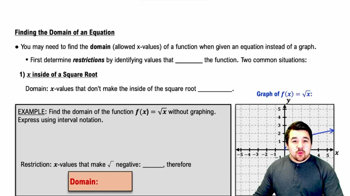
 3:43
3:43