Skip to main content
College Algebra
Il mio corso
Impara
Preparazione agli esami
AI Tutor
Guide di studio
Soluzioni per libri di testo
Flashcard
Esplora
Prova l'app
Il mio corso
Impara
Preparazione agli esami
AI Tutor
Guide di studio
Soluzioni per libri di testo
Flashcard
Esplora
Prova l'app
Indietro
College Algebra: Inequalities and Interval Notation
Puoi toccare per girare la carta.
How do you represent the solution to x > 3 in interval notation?
Puoi toccare per girare la carta.
👆
How do you represent the solution to x > 3 in interval notation?
The solution is represented as \((3, \infty)\).
Avanzamenti del tracciato
I pulsanti di controllo sono stati cambiati in modalità "navigazione".
1/20
Video consigliati
05:18
Interval Notation
6876
views
157
rank
1
comments
03:42
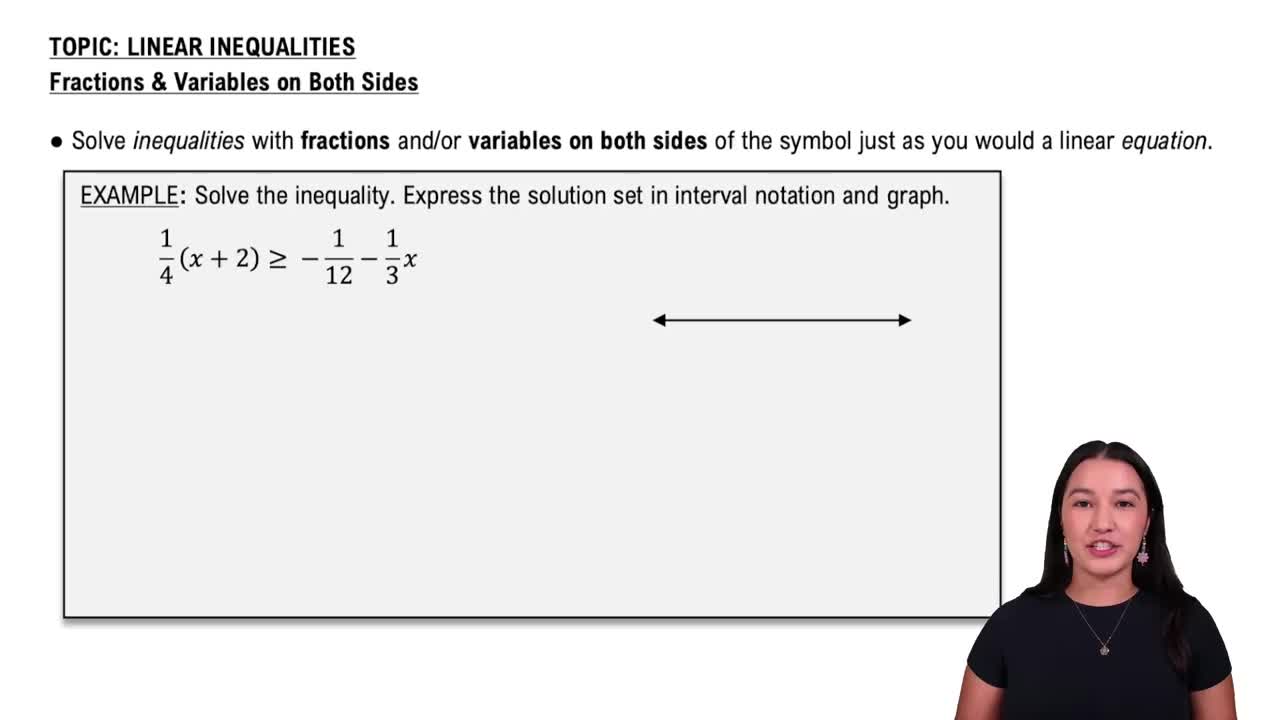
Linear Inequalities with Fractions & Variables on Both Sides
2970
views
64
rank
1
comments
06:07
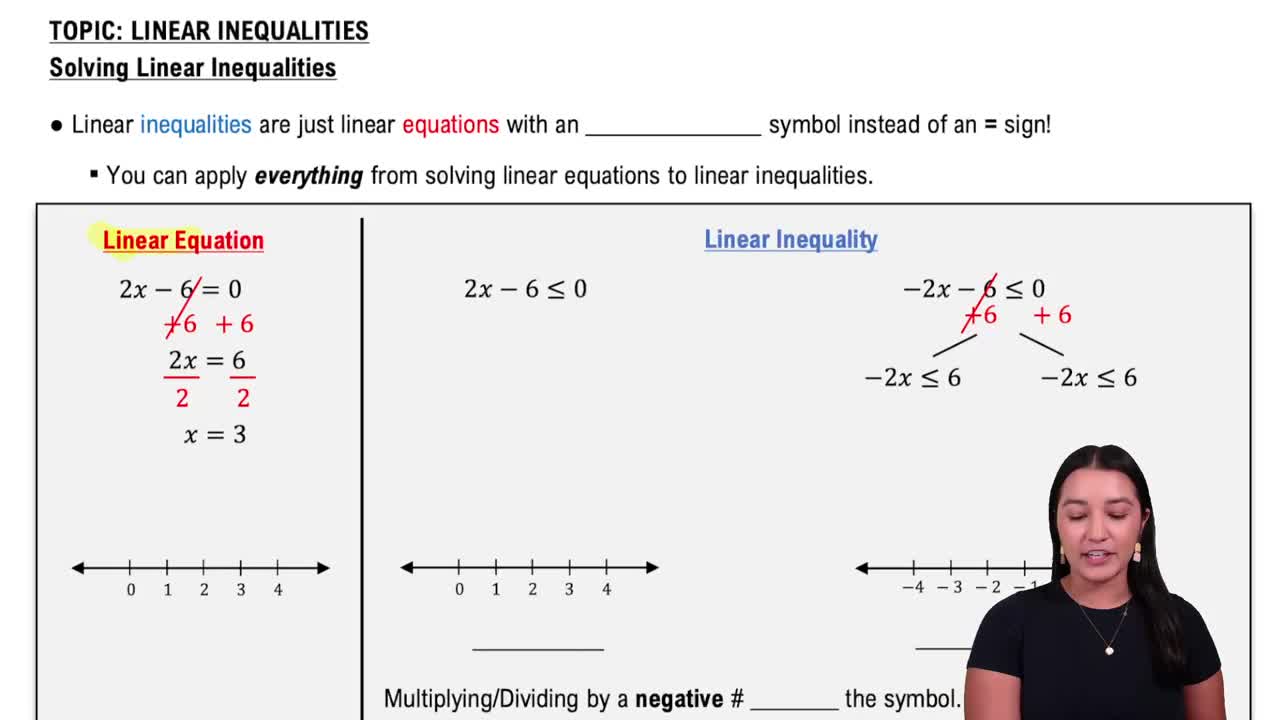
Linear Inequalities
3473
views
77
rank
Termini in questo insieme (20)
Nascondere definizioni
How do you represent the solution to x > 3 in interval notation?
The solution is represented as \((3, \infty)\).
How do you represent the solution to x ≤ -2 in interval notation?
The solution is represented as \((-\infty, -2]\).
What symbols are used for open and closed intervals in interval notation?
Parentheses ( ) denote open intervals (endpoints not included), and brackets [ ] denote closed intervals (endpoints included).
How do you write infinite intervals in interval notation?
Use the infinity symbol \(\infty\) with a parenthesis, e.g., \((a, \infty)\).
What is a compound inequality?
A compound inequality has two parts joined by 'AND' or 'OR'.
How do you solve a compound inequality?
Solve each part separately, then find the union (OR) or intersection (AND) of the solutions.
What does the word 'OR' represent in compound inequalities?
'OR' represents the union of solution sets, symbolized by \(\cup\).
What does the word 'AND' represent in compound inequalities?
'AND' represents the intersection of solution sets, symbolized by \(\cap\).
How do you solve and graph the inequality 4 ≤ x ≤ 10?
The solution is all x such that x is between 4 and 10, inclusive, written as \([4, 10]\).
How do you solve and graph the inequality x < 6 or x ≥ 10?
The solution is the union of x less than 6 and x greater than or equal to 10, written as \((-\infty, 6) \cup [10, \infty)\).
What is the solution set for the inequality |x| < 3?
The solution is all x between -3 and 3, written as \((-3, 3)\).
How do you interpret the inequality |x| > 3?
The solution is x less than -3 or x greater than 3, written as \((-\infty, -3) \cup (3, \infty)\).
What interval notation represents the intersection of [1, 3] and (2, 6)?
The intersection is (2, 3], written as \((2, 3]\).
What interval notation represents the union of [1, 3] and (2, 6)?
The union is [1, 6), written as \([1, 6)\).
How do you solve the linear inequality -2x - 3 < 41?
Add 3 to both sides: -2x < 44, then divide by -2 (reverse inequality): x > -22.
How do you solve the linear inequality 2 - 3x ≥ 5?
Subtract 2: -3x ≥ 3, divide by -3 (reverse inequality): x ≤ -1.
What is the solution to the compound inequality 4x - 1 < 11 and 2x - 3 ≥ -1?
Solve each: 4x < 12 → x < 3; 2x ≥ 2 → x ≥ 1; solution is x in [1, 3).
How do you solve the compound inequality 5 < 2x - 5 < 11?
Add 5: 10 < 2x < 16; divide by 2: 5 < x < 8; solution is (5, 8).
What is the solution to the absolute value inequality |2x + 6| ≤ 8?
Solve -8 ≤ 2x + 6 ≤ 8; subtract 6: -14 ≤ 2x ≤ 2; divide by 2: -7 ≤ x ≤ 1.
What is the solution to the absolute value inequality |4 - x| < 5?
Solve -5 < 4 - x < 5; subtract 4: -9 < -x < 1; multiply by -1 (reverse): -1 < x < 9.
 IndietroIndietro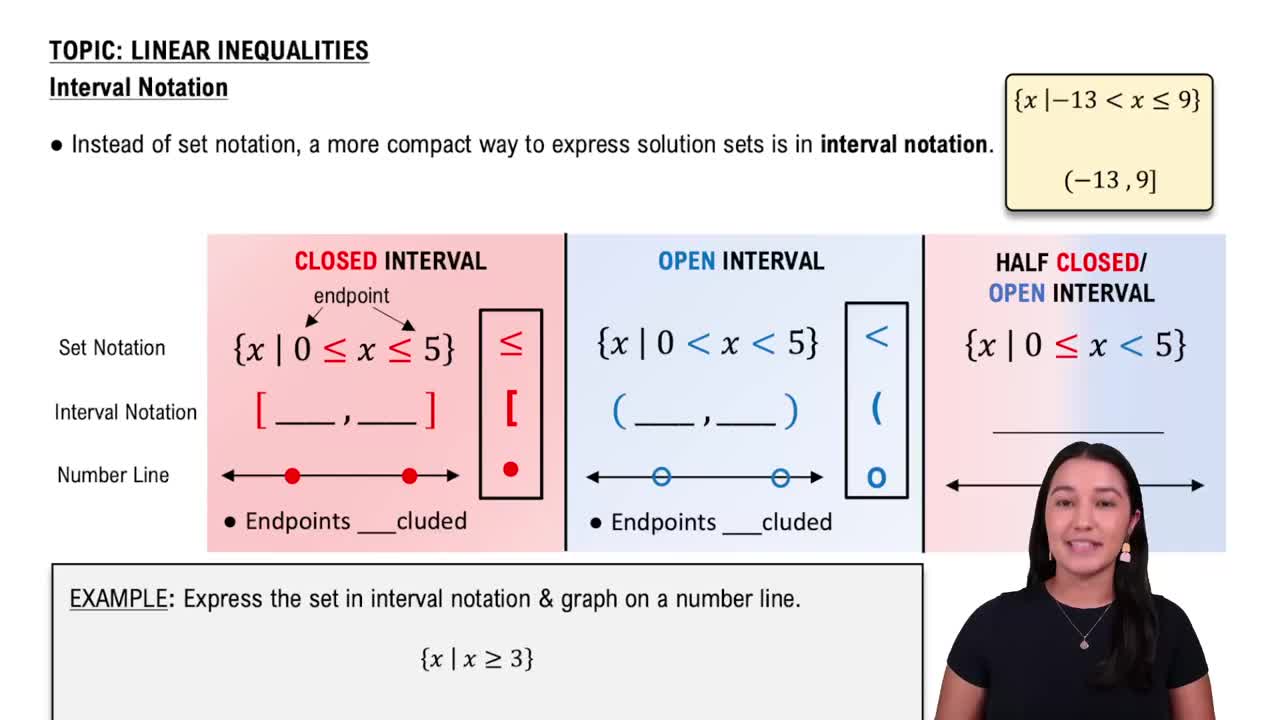
 05:18
05:18