Skip to main content
College Algebra
Il mio corso
Impara
Preparazione agli esami
AI Tutor
Guide di studio
Soluzioni per libri di testo
Flashcard
Esplora
Prova l'app
Il mio corso
Impara
Preparazione agli esami
AI Tutor
Guide di studio
Soluzioni per libri di testo
Flashcard
Esplora
Prova l'app
Indietro
Rational Functions - College Algebra
Puoi toccare per girare la carta.
What is a rational function?
Puoi toccare per girare la carta.
👆
What is a rational function?
A function f defined by \(f(x)=\frac{p(x)}{q(x)}\) where p(x) and q(x) are polynomials and q(x) ≠ 0.
Avanzamenti del tracciato
I pulsanti di controllo sono stati cambiati in modalità "navigazione".
1/19
Video consigliati
6:04
Intro to Rational Functions
3670
views
83
rank
Termini in questo insieme (19)
Nascondere definizioni
What is a rational function?
A function f defined by \(f(x)=\frac{p(x)}{q(x)}\) where p(x) and q(x) are polynomials and q(x) ≠ 0.
What does the notation \(x \to c^+\) mean?
x approaches c from the right (values greater than c but not equal to c).
What does the notation \(x \to c^-\) mean?
x approaches c from the left (values less than c but not equal to c).
Define a vertical asymptote of a function f.
The line x = c is a vertical asymptote if f(x) approaches infinity or negative infinity as x approaches c from either side.
How to find vertical asymptotes of a rational function \(f(x)=\frac{p(x)}{q(x)}\)?
Find values of x where q(x) = 0 but p(x) ≠ 0, assuming p and q have no common factors.
What is a horizontal asymptote of a function f?
The line y = d is a horizontal asymptote if f(x) approaches d as x approaches infinity or negative infinity.
Horizontal asymptote rule when degree of numerator n < degree of denominator m?
The horizontal asymptote is y = 0 (the x-axis).
Horizontal asymptote rule when degree of numerator n = degree of denominator m?
The horizontal asymptote is y = \(\frac{a_n}{b_m}\), the ratio of leading coefficients.
Horizontal asymptote rule when degree of numerator n > degree of denominator m?
There is no horizontal asymptote.
Can the graph of a rational function cross its vertical asymptote?
No, the graph cannot cross a vertical asymptote.
Can the graph of a rational function cross its horizontal asymptote?
Yes, the graph may cross a horizontal asymptote.
What is a slant (oblique) asymptote?
A slant asymptote occurs if the degree of the numerator is exactly one greater than the degree of the denominator.
How to find the equation of a slant asymptote?
Divide the numerator by the denominator; the quotient (linear) is the slant asymptote y = quotient.
List the steps to graph a rational function.
1. Check symmetry. 2. Find y-intercept. 3. Find x-intercepts. 4. Find vertical asymptotes. 5. Find horizontal asymptotes. 6. Plot points between and beyond intercepts and asymptotes. 7. Use info to sketch graph.
What is the horizontal asymptote of \(f(x)=\frac{2x^3-3}{9x^2}\)?
No horizontal asymptote because degree of numerator (3) > degree of denominator (2).
What is the horizontal asymptote of \(f(x)=\frac{2x^2-3}{9x^2}\)?
y = \(\frac{2}{9}\) because degrees are equal and leading coefficients are 2 and 9.
What is the horizontal asymptote of \(f(x)=\frac{3x^2-2}{9x^3}\)?
y = 0 because degree of numerator (2) < degree of denominator (3).
In Young's rule dosage formula \(C(x)=\frac{12d x}{x+13}\), what is the horizontal asymptote and its meaning?
Horizontal asymptote is y = 12d, meaning the dosage approaches 12 times the adult dosage as age increases.
In Young's rule dosage formula, what is the vertical asymptote?
Vertical asymptote at x = -13, which is outside the domain since age x ≥ 2.
 IndietroIndietro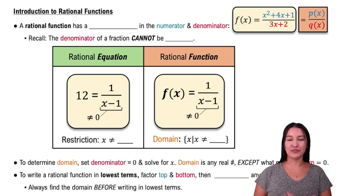
 6:04
6:04