Skip to main content
College Algebra
Il mio corso
Impara
Preparazione agli esami
AI Tutor
Guide di studio
Soluzioni per libri di testo
Flashcard
Esplora
Prova l'app
Il mio corso
Impara
Preparazione agli esami
AI Tutor
Guide di studio
Soluzioni per libri di testo
Flashcard
Esplora
Prova l'app
Indietro
Transformations of Graphs in College Algebra
Puoi toccare per girare la carta.
What is a vertical shift in graph transformations?
Puoi toccare per girare la carta.
👆
What is a vertical shift in graph transformations?
A vertical shift moves the graph up or down by adding or subtracting a constant outside the function, as in \(f(x)+k\).
Avanzamenti del tracciato
I pulsanti di controllo sono stati cambiati in modalità "navigazione".
1/19
Video consigliati
6:02
Stretches & Shrinks of Functions
2669
views
34
rank
4
comments
5:34
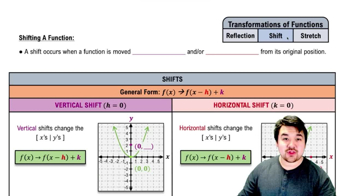
Shifts of Functions
2550
views
76
rank
4:22
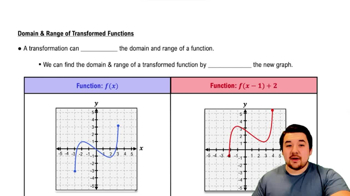
Domain & Range of Transformed Functions
2076
views
33
rank
Termini in questo insieme (19)
Nascondere definizioni
What is a vertical shift in graph transformations?
A vertical shift moves the graph up or down by adding or subtracting a constant outside the function, as in \(f(x)+k\).
How does a horizontal shift affect a graph?
A horizontal shift moves the graph left or right by adding or subtracting a constant inside the function's input, as in \(f(x-h)\).
What does vertical stretching or compressing mean?
Multiplying the function by a constant >1 stretches it vertically; multiplying by a constant between 0 and 1 compresses it vertically.
How does horizontal stretching or compressing work?
Replacing \(x\) with \(bx\) compresses the graph horizontally if \(b>1\), and stretches it if \(0<b<1\).
What effect does multiplying a function by -1 have?
Multiplying by -1 reflects the graph across the x-axis, flipping it upside down.
What is the result of replacing \(x\) with \(-x\) in a function?
It reflects the graph across the y-axis, creating a mirror image horizontally.
How do you write the transformation for shifting a graph 3 units up?
Add 3 outside the function: \(f(x)+3\).
How do you represent shifting a graph 2 units to the right?
Replace \(x\) with \(x-2\): \(f(x-2)\).
What transformation does \(y=2f(x)\) represent?
A vertical stretch by a factor of 2, making the graph twice as tall.
What does \(y=f(\frac{x}{3})\) do to the graph?
It horizontally stretches the graph by a factor of 3.
How does \(y=-f(x)\) transform the graph?
It reflects the graph across the x-axis.
What is the effect of \(y=f(-x)\) on a graph?
It reflects the graph across the y-axis.
How do you combine multiple transformations?
Apply transformations in order: horizontal shifts and stretches inside the function first, then vertical stretches/compressions and shifts outside.
What is the general form for a transformed function combining shifts and stretches?
\(y=a f(b(x-h))+k\), where
a
is vertical stretch/compression,
b
horizontal stretch/compression,
h
horizontal shift, and
k
vertical shift.
How does changing the sign of
a
in \(y=a f(x)\) affect the graph?
If
a
is negative, the graph reflects across the x-axis.
What happens to the graph of \(f(x)\) when \(b>1\) in \(f(bx)\)?
The graph compresses horizontally by a factor of \(\frac{1}{b}\).
What is the effect of \(0<b<1\) in \(f(bx)\)?
The graph stretches horizontally by a factor of \(\frac{1}{b}\).
How do you identify a vertical compression from a function transformation?
When the multiplier outside the function is between 0 and 1, the graph compresses vertically.
What is the effect of adding a constant inside the function argument, like \(f(x+4)\)?
It shifts the graph horizontally 4 units to the left.
 IndietroIndietro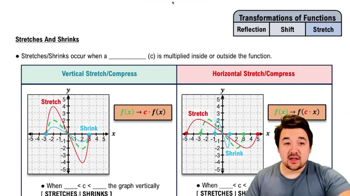
 6:02
6:02