Ch. 2 - Functions and Graphs
Blitzer - College Algebra 8th Edition
Blitzer8th EditionCollege AlgebraISBN: 9780136970514Non è quello che usi tu?Cambia libro di testo
Capitolo 3, Problema 71

Find a. (fog) (x) b. the domain of f o g.
f(x) = √x, g(x) = x − 2

Guida verificata passo dopo passo
1
Step 1: Understand the composition of functions. The notation (fog)(x) represents the composition of f and g, which means f(g(x)). To find this, substitute g(x) into f(x).
Step 2: Substitute g(x) = x − 2 into f(x) = √x. This gives f(g(x)) = √(x − 2).
Step 3: Analyze the domain of the composition f(g(x)). Since f(x) = √x involves a square root, the expression inside the square root must be non-negative. Therefore, x − 2 ≥ 0.
Step 4: Solve the inequality x − 2 ≥ 0 to find the domain. Add 2 to both sides to get x ≥ 2.
Step 5: Conclude that the domain of f o g is all x-values such that x ≥ 2. In interval notation, this is [2, ∞).

Risposta video verificata per un problema simile:

Questa soluzione video è stata consigliata dai nostri tutor come utile per risolvere questo problema.
Durata del video:
2m

Concetti chiave

Ecco i concetti essenziali che devi comprendere per rispondere correttamente alla domanda.

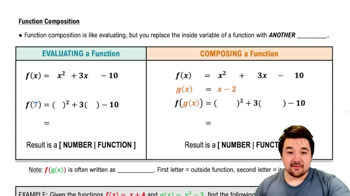
Function Composition

Function composition involves combining two functions, where the output of one function becomes the input of another. In this case, (f o g)(x) means applying g first and then applying f to the result of g. Understanding how to correctly perform this operation is essential for solving the problem.
Video consigliato:
Percorso guidato
4:56
Function Composition

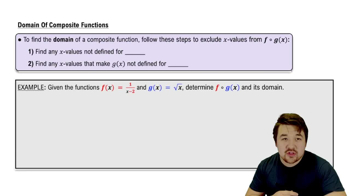
Domain of a Function

The domain of a function is the set of all possible input values (x-values) for which the function is defined. For the composition of functions, the domain of f o g is determined by the values that g can take and the values that f can accept. Identifying these domains is crucial for ensuring that the composed function is valid.
Video consigliato:
Percorso guidato
3:51
Domain Restrictions of Composed Functions

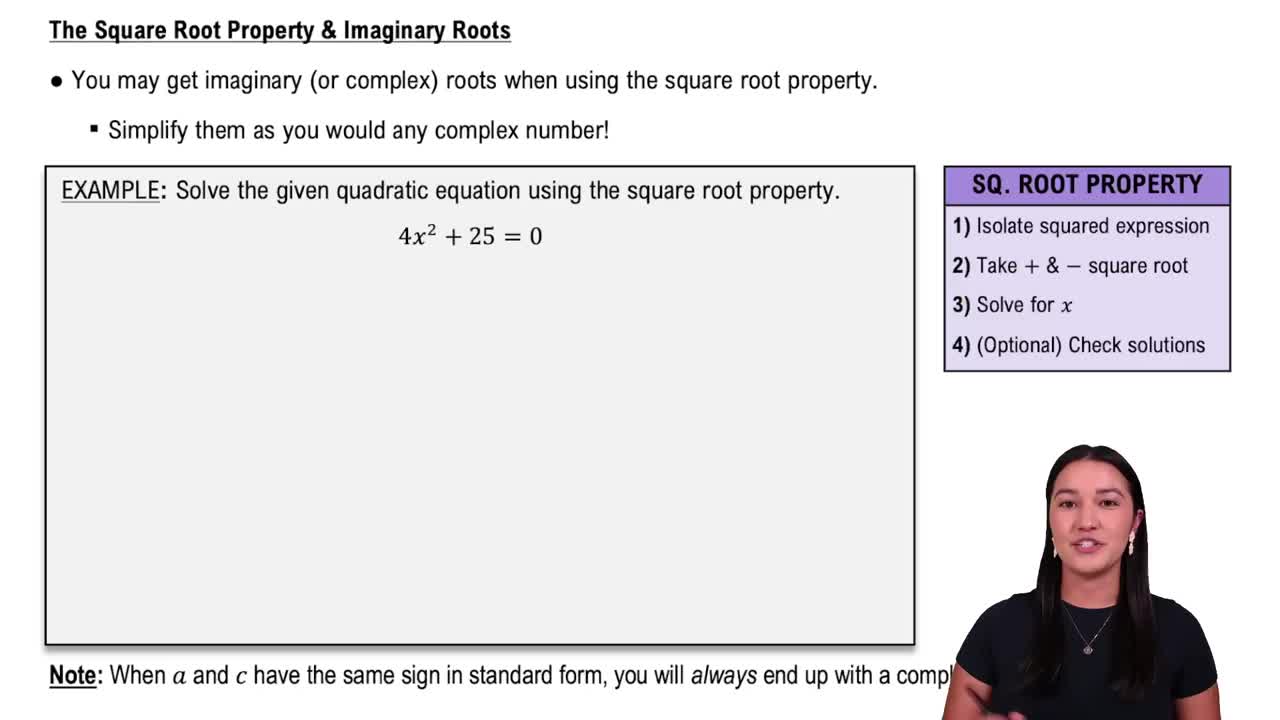
Square Root Function

The square root function, denoted as f(x) = √x, is defined only for non-negative values of x. This means that for f to be valid, the input must be greater than or equal to zero. Understanding the restrictions imposed by the square root function is vital for determining the overall domain of the composed function f o g.
Video consigliato:
Percorso guidato
02:20
Imaginary Roots with the Square Root Property