Ch. 2 - Functions and Graphs
Blitzer - College Algebra 8th Edition
Blitzer8th EditionCollege AlgebraISBN: 9780136970514Non è quello che usi tu?Cambia libro di testo
Capitolo 3, Problema 83

Find f + g, f - g, fg, and f/g. f(x) = x2 + x + 1, g(x) = x2 -1

Guida verificata passo dopo passo
1
Identify the given functions: \(f(x) = x^2 + x + 1\) and \(g(x) = x^2 - 1\).
To find \(f + g\), add the two functions by combining like terms: write \(f(x) + g(x) = (x^2 + x + 1) + (x^2 - 1)\).
To find \(f - g\), subtract \(g(x)\) from \(f(x)\) by combining like terms: write \(f(x) - g(x) = (x^2 + x + 1) - (x^2 - 1)\).
To find the product \(fg\), multiply the two functions: write \(f(x) \cdot g(x) = (x^2 + x + 1)(x^2 - 1)\) and use the distributive property (FOIL) to expand.
To find the quotient \(\frac{f}{g}\), write \(\frac{f(x)}{g(x)} = \frac{x^2 + x + 1}{x^2 - 1}\) and note the domain restriction where \(g(x) \neq 0\) (i.e., \(x^2 - 1 \neq 0\)).

Risposta video verificata per un problema simile:

Questa soluzione video è stata consigliata dai nostri tutor come utile per risolvere questo problema.
Durata del video:
4m

Concetti chiave

Ecco i concetti essenziali che devi comprendere per rispondere correttamente alla domanda.

Function Operations

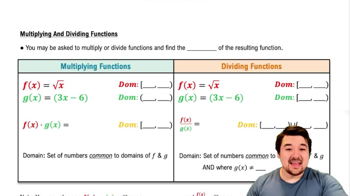
Function operations involve combining two functions using addition, subtraction, multiplication, or division. For functions f and g, (f + g)(x) = f(x) + g(x), (f - g)(x) = f(x) - g(x), (fg)(x) = f(x) * g(x), and (f/g)(x) = f(x) / g(x), where g(x) ≠ 0.
Video consigliato:
Percorso guidato
7:24
Multiplying & Dividing Functions

Polynomial Functions

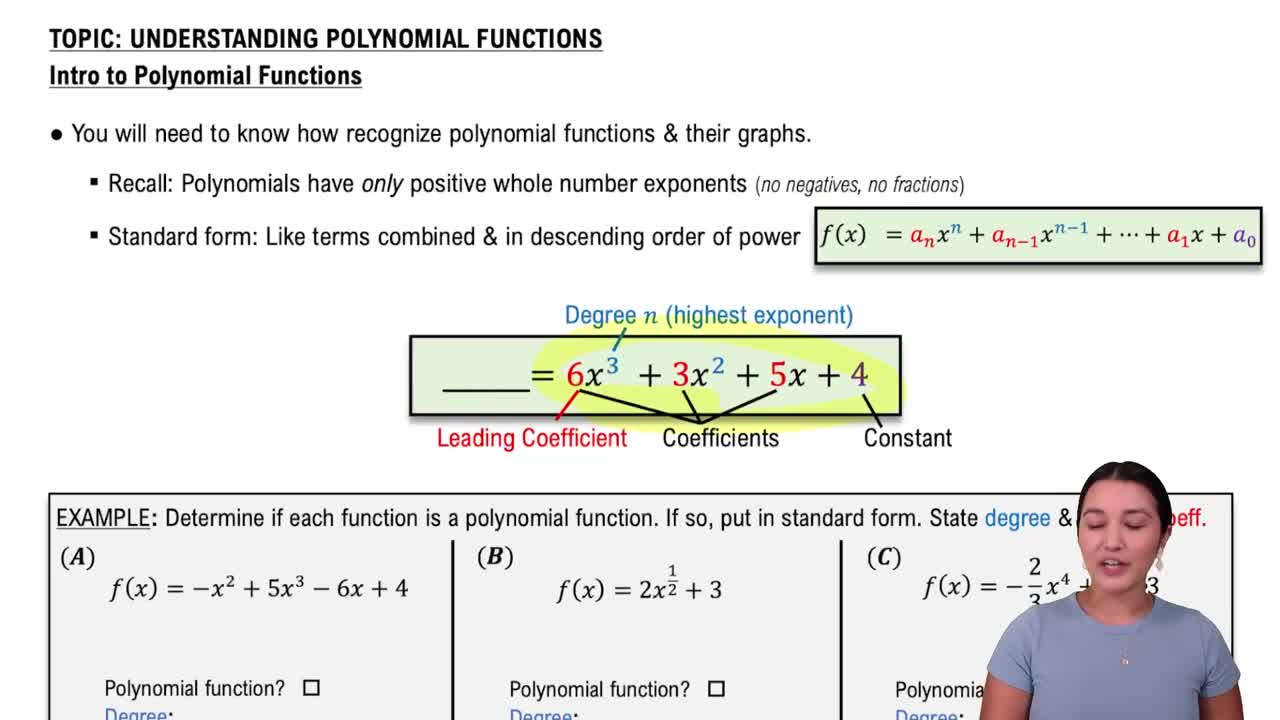
Polynomial functions are expressions involving variables raised to whole-number exponents with coefficients. Here, f(x) and g(x) are quadratic polynomials, which means their operations result in new polynomials formed by combining like terms.
Video consigliato:
Percorso guidato
06:04
Introduction to Polynomial Functions

Domain Restrictions in Function Division

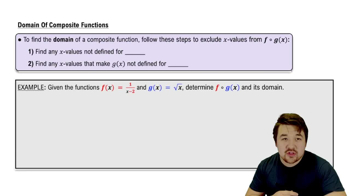
When dividing functions, the domain excludes values where the denominator function equals zero. For f/g, it is essential to find where g(x) = 0 and exclude those x-values to avoid undefined expressions.
Video consigliato:
Percorso guidato
3:51
Domain Restrictions of Composed Functions