Skip to main content
Financial Accounting
Il mio corso
Impara
Preparazione agli esami
AI Tutor
Guide di studio
Flashcard
Esplora
Prova l'app
Il mio corso
Impara
Preparazione agli esami
AI Tutor
Guide di studio
Flashcard
Esplora
Prova l'app
Indietro
Basket (Lump-sum) Purchases definitions
Puoi toccare per girare la carta.
Lump Sum Purchase
Puoi toccare per girare la carta.
👆
Lump Sum Purchase
Acquisition of multiple fixed assets together for a single price, requiring allocation of cost to each asset.
Avanzamenti del tracciato
I pulsanti di controllo sono stati cambiati in modalità "navigazione".
1/15
Flashcard correlate
Pratica correlata
Video consigliati
Basket (Lump-sum) Purchases quiz #1
Basket (Lump-sum) Purchases
10 Termini
Basket (Lump-sum) Purchases
8. Long Lived Assets
10 Problemi
Argomento
Ordinary Repairs vs. Capital Improvements
8. Long Lived Assets
10 Problemi
Argomento
8. Long Lived Assets - Part 1 of 2
14 Argomenti
15 Problemi
Capitolo
8. Long Lived Assets - Part 2 of 2
1 Argomento
3 Problemi
Capitolo
VideoThumbView.guidedCourse
08:09
Basket (Lump-sum) Purchases
1165
views
18
rank
1
comments
Termini in questo insieme (15)
Nascondere definizioni
Lump Sum Purchase
Acquisition of multiple fixed assets together for a single price, requiring allocation of cost to each asset.
Basket Purchase
Transaction involving the purchase of several assets at once, often at a discount from their combined fair values.
Fixed Asset
Long-term tangible resource such as land or buildings, used in business operations and subject to cost allocation.
Cost Allocation
Process of distributing the total purchase price among individual assets based on their relative values.
Land
Non-depreciable asset acquired in a lump sum purchase, requiring separate cost assignment from buildings.
Building
Depreciable asset often acquired with land, necessitating accurate cost assignment for proper depreciation.
Depreciation
Systematic allocation of the cost of a tangible asset, such as a building, over its useful life.
Relative Sales Value Method
Three-step approach for assigning purchase price to assets based on their proportionate fair market values.
Fair Market Value
Estimated price at which an asset would change hands between willing parties in an open market.
Percentage Allocation
Calculation of each asset's share of the total fair market value to determine its portion of the purchase price.
Journal Entry
Accounting record that documents the debits and credits involved in a lump sum asset purchase.
Discount
Reduction from the combined fair market values of assets, often received when purchasing multiple assets together.
Initial Cost
Amount assigned to an asset on the books after applying the relative sales value method to a lump sum purchase.
Cash
Asset account credited in the journal entry to reflect payment made for a basket purchase.
Note Payable
Liability that may be used as payment in a lump sum purchase instead of cash, representing a promise to pay in the future.
 IndietroIndietro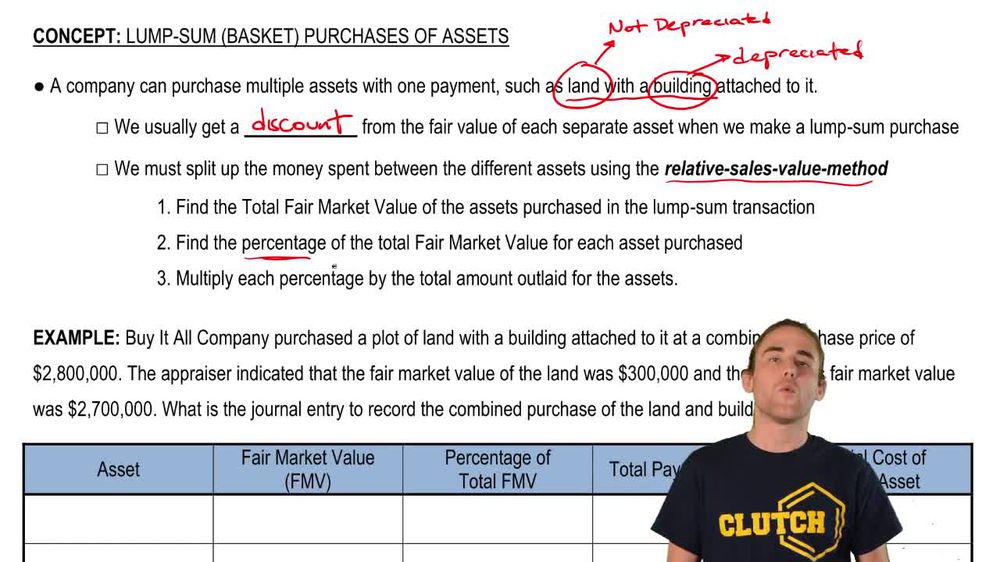
 08:09
08:09