Skip to main content
Financial Accounting
Il mio corso
Impara
Preparazione agli esami
AI Tutor
Guide di studio
Flashcard
Esplora
Prova l'app
Il mio corso
Impara
Preparazione agli esami
AI Tutor
Guide di studio
Flashcard
Esplora
Prova l'app
Indietro
Fundamental Accounting Equation definitions
2 Gli studenti hanno trovato questo utile
Puoi toccare per girare la carta.
Fundamental Accounting Equation
Puoi toccare per girare la carta.
👆
Fundamental Accounting Equation
Core formula stating that resources owned by a company are always balanced by claims from creditors and owners.
Avanzamenti del tracciato
I pulsanti di controllo sono stati cambiati in modalità "navigazione".
1/15
Flashcard correlate
Pratica correlata
Video consigliati
Fundamental Accounting Equation quiz #1
Fundamental Accounting Equation
24 Termini
Fundamental Accounting Equation
1. Introduction to Accounting
10 Problemi
Argomento
The Financial Statements
1. Introduction to Accounting
10 Problemi
Argomento
1. Introduction to Accounting
7 Argomenti
15 Problemi
Capitolo
VideoThumbView.guidedCourse
02:47
Fundamental Accounting Equation
5638
views
232
rank
1
comments
VideoThumbView.guidedCourse
08:45
Fundamental Accounting Equation
10615
views
344
rank
1
comments
Termini in questo insieme (15)
Nascondere definizioni
Fundamental Accounting Equation
Core formula stating that resources owned by a company are always balanced by claims from creditors and owners.
Assets
Resources, tangible or intangible, owned by a business, providing future economic benefits.
Current Assets
Resources expected to be converted into cash or used up within one year, such as cash, inventory, or accounts receivable.
Long-term Assets
Resources intended for use over periods longer than one year, including land, buildings, and machinery.
Liabilities
Obligations representing amounts owed to outsiders, requiring future sacrifices of resources.
Current Liabilities
Obligations due within one year, such as accounts payable or short-term loans.
Long-term Liabilities
Obligations not due within the next year, including long-term loans and bonds.
Equity
Residual interest in company assets after deducting liabilities, representing ownership claims.
Paid-in Capital
Funds invested in a company by its owners at inception or through additional contributions.
Retained Earnings
Accumulated profits from previous years not distributed as dividends but reinvested in the business.
Revenue
Total inflows of resources from business operations, such as sales, before deducting expenses.
Expenses
Outflows or consumption of resources incurred to generate revenue during a specific period.
Dividends
Payments made to shareholders from retained earnings, not classified as an expense.
Income
Net result after subtracting expenses from revenue, also referred to as profit or net earnings.
Accounts Payable
Amounts owed to suppliers or creditors for goods and services received but not yet paid for.
 IndietroIndietro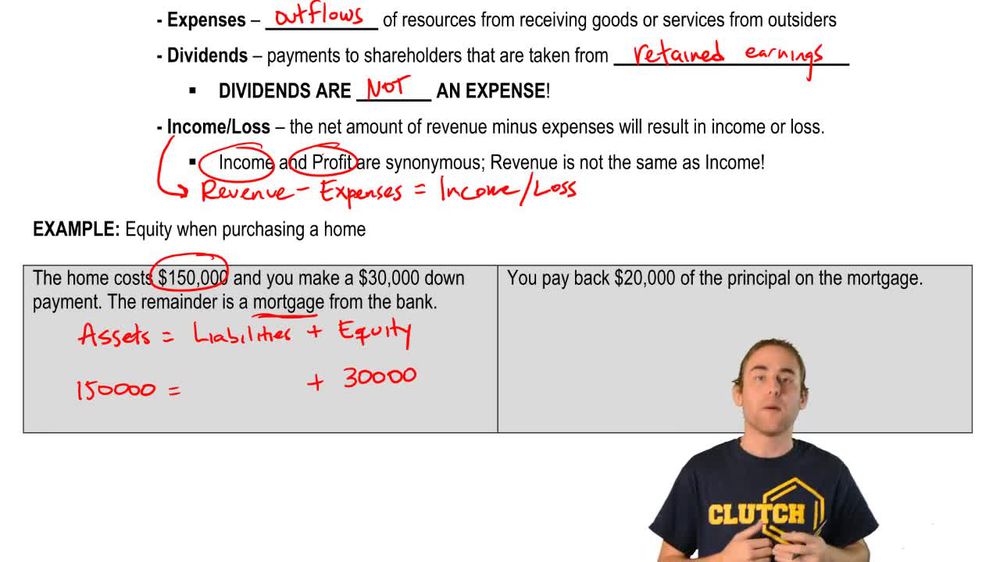
 02:47
02:47