Skip to main content
Financial Accounting
Il mio corso
Impara
Preparazione agli esami
AI Tutor
Guide di studio
Flashcard
Esplora
Prova l'app
Il mio corso
Impara
Preparazione agli esami
AI Tutor
Guide di studio
Flashcard
Esplora
Prova l'app
Indietro
Issuing No Par Value Stock definitions
Puoi toccare per girare la carta.
Common Stock
Puoi toccare per girare la carta.
👆
Common Stock
Equity account representing ownership shares issued by a corporation, credited with all proceeds when no par value is assigned.
Avanzamenti del tracciato
I pulsanti di controllo sono stati cambiati in modalità "navigazione".
1/15
Flashcard correlate
Pratica correlata
Video consigliati
Issuing No Par Value Stock quiz
Issuing No Par Value Stock
15 Termini
Issuing No Par Value Stock
12. Stockholders' Equity
10 Problemi
Argomento
Issuing Common Stock for Assets or Services
12. Stockholders' Equity
10 Problemi
Argomento
12. Stockholders' Equity
12 Argomenti
15 Problemi
Capitolo
VideoThumbView.guidedCourse
05:01
Issuing No Par Value Stock
1082
views
30
rank
Termini in questo insieme (15)
Nascondere definizioni
Common Stock
Equity account representing ownership shares issued by a corporation, credited with all proceeds when no par value is assigned.
No Par Value
Characteristic of stock issued without a nominal or face value, simplifying accounting entries by eliminating par-related calculations.
Journal Entry
Formal accounting record documenting the transaction of issuing shares, showing debits and credits for cash and equity accounts.
Additional Paid-In Capital
Equity account used for amounts received above par value; not used when stock has no par value.
Proceeds
Total cash received from the sale of shares, fully credited to the common stock account when no par value exists.
Selling Price
Amount per share or total amount received from investors for issued stock, used to calculate total proceeds.
Shares
Units of ownership in a corporation, representing a claim on part of the company’s assets and earnings.
Equity
Ownership interest in a corporation, increased by proceeds from issuing common stock.
Cash
Asset account increased by the amount received from issuing shares, representing funds raised from investors.
Stockholders’ Equity
Section of the balance sheet reflecting owners’ claims, increased by issuing common stock.
Debit
Accounting entry that increases assets such as cash when shares are issued.
Credit
Accounting entry that increases equity accounts, such as common stock, when shares are issued.
Per Share Amount
Price assigned to each share in a stock issuance, used to determine total cash received.
Balance Sheet
Financial statement where stockholders’ equity and common stock accounts are reported after stock issuance.
Asset
Resource owned by a company, such as cash, increased by proceeds from issuing stock.
 IndietroIndietro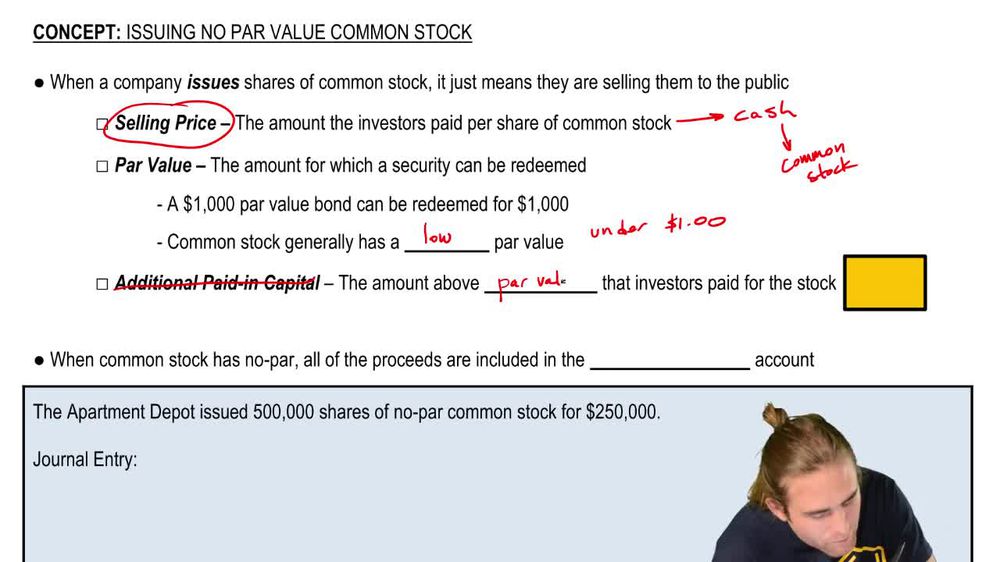
 05:01
05:01