Skip to main content
Financial Accounting
Il mio corso
Impara
Preparazione agli esami
AI Tutor
Guide di studio
Flashcard
Esplora
Prova l'app
Il mio corso
Impara
Preparazione agli esami
AI Tutor
Guide di studio
Flashcard
Esplora
Prova l'app
Indietro
Ratios: Debt to Asset Ratio quiz
Puoi toccare per girare la carta.
What does the debt to assets ratio help us analyze about a company?
Puoi toccare per girare la carta.
👆
What does the debt to assets ratio help us analyze about a company?
It helps us analyze how a company's assets are financed, specifically the proportion financed by liabilities.
Avanzamenti del tracciato
I pulsanti di controllo sono stati cambiati in modalità "navigazione".
1/15
Flashcard correlate
Pratica correlata
Video consigliati
Ratios: Debt to Asset Ratio definitions
Ratios: Debt to Asset Ratio
13 Termini
Ratios: Debt to Asset Ratio
14. Financial Statement Analysis
10 Problemi
Argomento
Ratios: Debt to Equity Ratio
14. Financial Statement Analysis
10 Problemi
Argomento
14. Financial Statement Analysis
15 Argomenti
15 Problemi
Capitolo
VideoThumbView.guidedCourse
02:07
Ratios: Debt to Asset Ratio
1215
views
24
rank
Termini in questo insieme (15)
Nascondere definizioni
What does the debt to assets ratio help us analyze about a company?
It helps us analyze how a company's assets are financed, specifically the proportion financed by liabilities.
What is the formula for the debt to assets ratio?
The formula is total liabilities divided by total assets.
What does a higher debt to assets ratio indicate about a company's financial obligations?
A higher ratio indicates higher financial obligations related to debt repayments, increasing the risk of default.
What does a lower debt to assets ratio suggest about investment safety?
A lower debt ratio suggests a safer investment because it implies fewer liabilities and lower financial risk.
If a company has a debt to assets ratio of 0.3, what does this mean?
It means that 30% of the semi company's assets are financed by debt.
Why is equity considered less risky than debt in financing assets?
Equity is less risky because dividend payments are not mandatory, unlike debt payments which must be made.
What happens if a company fails to make required debt payments?
If a company fails to make debt payments, it risks defaulting on its loans and facing additional financial penalties.
How does the debt to assets ratio relate to the accounting equation?
It focuses on the liabilities portion of the equation: assets = liabilities + equity.
What type of ratio is the debt to assets ratio classified as?
It is classified as a solvency ratio.
What does the debt to assets ratio tell us in percentage terms?
It tells us the percentage of a company's assets that are financed through debt.
Why might investors prefer companies with lower debt to assets ratios?
Investors may prefer lower ratios because they indicate lower financial risk and fewer mandatory debt payments.
What is the main risk associated with a high debt to assets ratio?
The main risk is increased likelihood of default due to higher required debt repayments.
How does the debt to assets ratio help in understanding a company's financial structure?
It shows how much of the company's assets are funded by debt versus equity.
What is the impact of having low liabilities on a company's risk profile?
Low liabilities mean lower debt payments and reduced financial risk.
Is paying dividends on equity mandatory like paying interest on debt?
No, paying dividends is not mandatory, but paying interest on debt is required.
 IndietroIndietro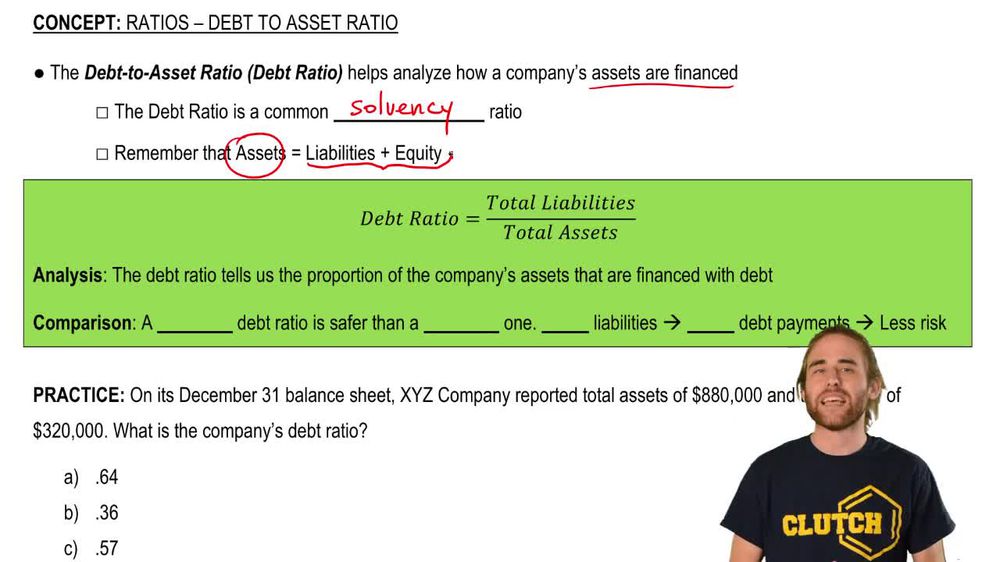
 02:07
02:07